


Style Egyptian / Ref.15678
Emile Hébert and Georges Servant, Egyptian Revival Clock, 19th Century
Dimensions
Width: 49 cm / 19'' ¼
Height: 75 cm / 29'' ½
Depth: 16 cm / 6'' ¼
Georges Servant (1828-1890) took over the family foundry on Rue Vieille du Temple in 1855.
In response to the contemporary fascination with ancient Egypt in France, he focused his production on decorative objects inspired by Greco-Egyptian antiquity.
His skill as a bronzier was widely recognized, notably through his participation in the 1862 London International Exhibition.
Emile Hébert (1828-1893) trained under his father, Pierre Hébert, and Jean-Jacques Feuchère.
He exhibited at the Salon des Artistes Français from 1849 to 1893, and at the Universal Exhibitions of 1855, 1867, and 1878, winning gold medals at the latter two.
Neo-Egyptian subjects were a hallmark of his work and significantly contributed to his success.
In 1878, the Universal Exhibition jury noted in its report that Hébert’s chasing was handled with a master’s hand.
The two artists frequently collaborated to present joint works at these major international events.
Attributed to Emile Hébert and Georges Servant, this clock is a refined Neo-Egyptian creation that blends exotic motifs with the aesthetic appeal of precious materials, including patinated and gilt bronze, rouge antico marble, and Belgian black marble.
The piece is designed in the form of an Egyptian temple facade.
The central black marble pedestal supports a gilt bronze statuette of Cleopatra, while the rouge antico marble elements serve as bases for two reclining lions, whose formal pose is characteristic of Egyptian sculpture.
The depiction of the last Queen of Egypt reflects 19th-century sensibilities: a sensual queen whose drapery emphasizes her form.
Shown in a slight contrapposto, she steps forward with a melancholic expression.
She is recognizable by the pharaonic scepter (was) featuring the head of the god Seth and the lotus flower she holds in her left hand—a symbol of the cycle of life and renewal.
The clock face is crowned by a gilt bronze appliqué reminiscent of a pectoral jewel bearing the image of the deity Nekhbet.
The decoration is completed by pseudo-hieroglyphs engraved on the central body and a pair of outspread bronze wings adorning the cornice, centered around a sacred scarab.
Biographies of Georges Servant and Emile Hébert
Description of the Work
Informations
Price: on request
Recommended for you :
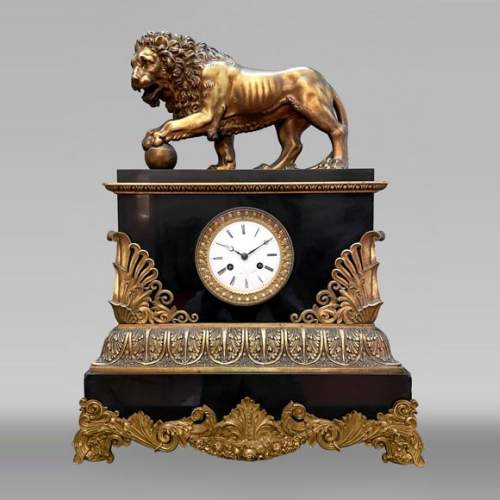
Dimensions:
Width: 50
Height: 63
Depth: 19
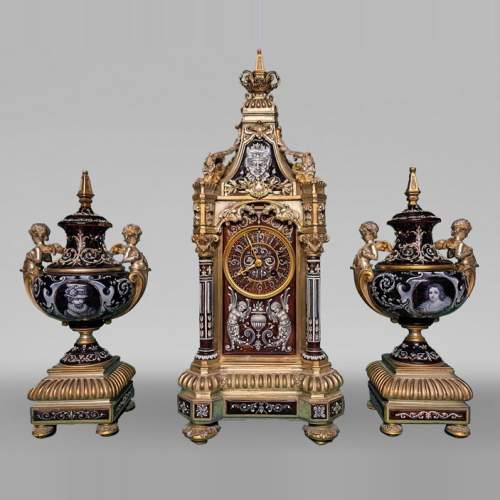
Dimensions:
Width: 22
Height: 53
Depth: 19
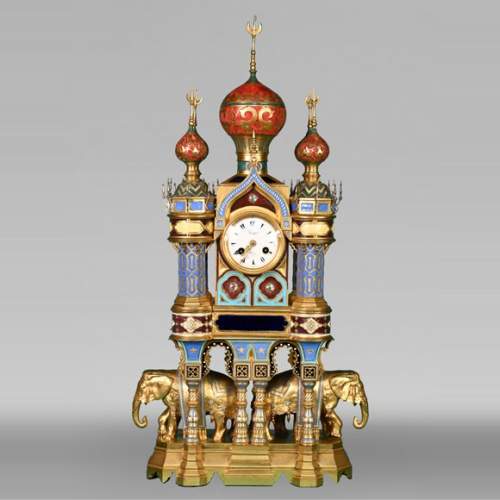
Dimensions:
Width: 28
Height: 57
Depth: 13
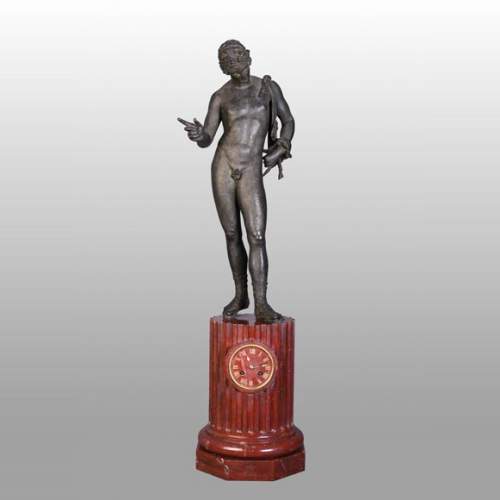
Dimensions:
Width: 28
Height: 90
Diameter: 21
Dimensions:
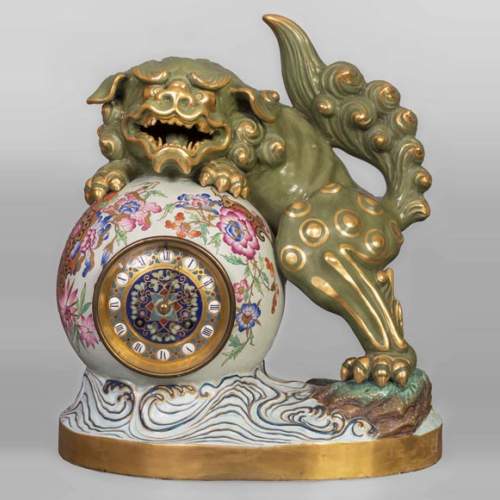
Width: 31
Height: 35
Depth: 19
Dimensions:
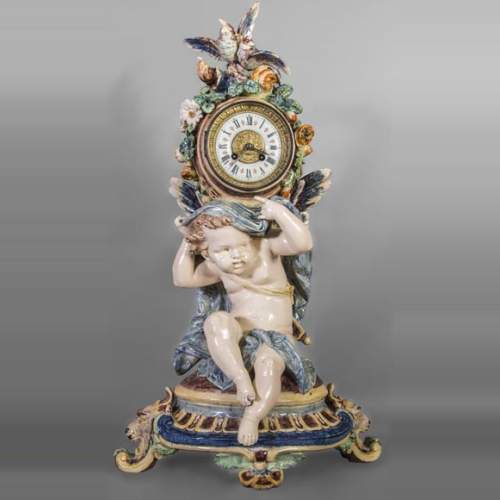
Width: 38
Height: 69
Depth: 11
Dimensions:
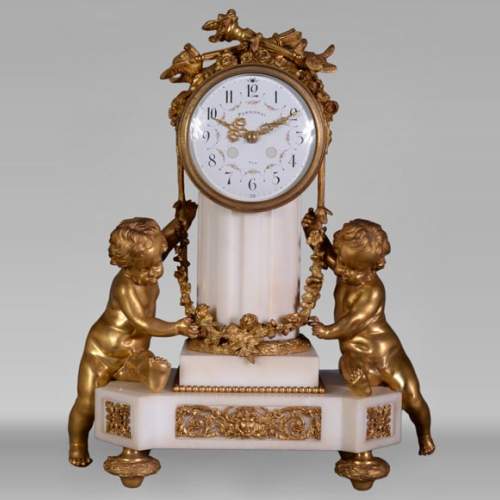
Width: 38
Height: 49
Depth: 22
Dimensions:
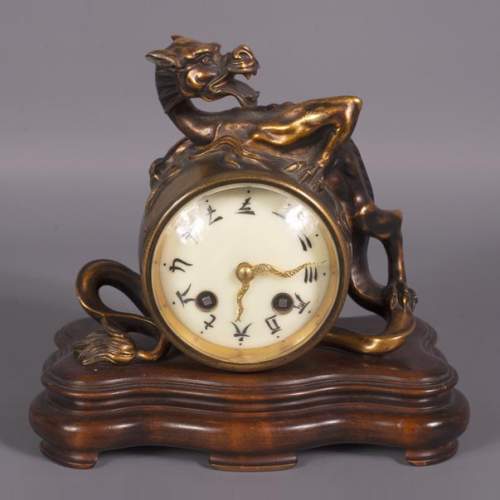
Width: 19
Height: 17
Depth: 11
Dimensions:
Width: 133
Height: 119
Depth: 25
Dimensions:
Width: 50
Height: 48
Depth: 18
Dimensions:
Width: 44
Height: 48
Depth: 18
Dimensions:
Width: 39
Height: 85
Depth: 18