Hippolyte Sauvrezy
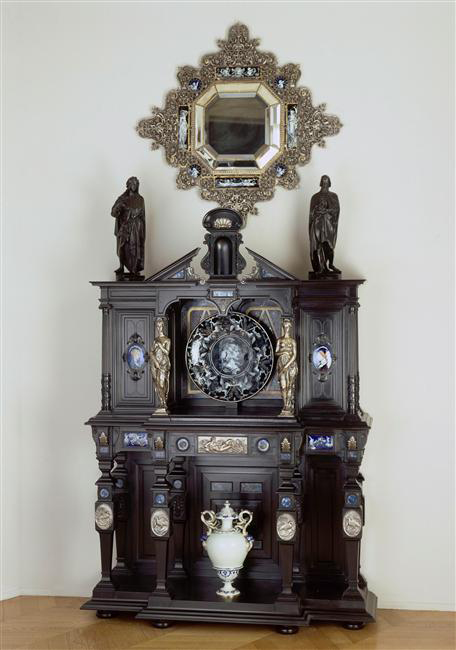
Download PDFBorn in Laon in 1815, Hippolyte Sauvrezy moved to Paris at the age of 16 before training in Lyon under Baltard. He quickly gained recognition for his virtuosic creations, characterized by thoughtful architecture and a masterful command of sculpture. He received several awards at the exhibitions of his day, most notably a gold medal at the 1867 Exposition Universelle, where he displayed several Neo-Renaissance pieces—including a cabinet crafted from ebony, silvered bronze, and enamel. This superb cabinet is now held in the collection of the Musée d'Orsay in Paris.
Sauvrezy played a key role in the revival of a strong preference for enamel as a decorative element in furniture, collaborating with the finest enamellers of his era.
He specialized in creating furniture with classical forms, fashioned from ebony and embellished with precious stone inlays and marquetry. His affinity for Renaissance-style works became increasingly pronounced over time, particularly during the 1850s and 1860s.
In the 1840s, he opened his shop and workshop at 23 Rue de Turenne.
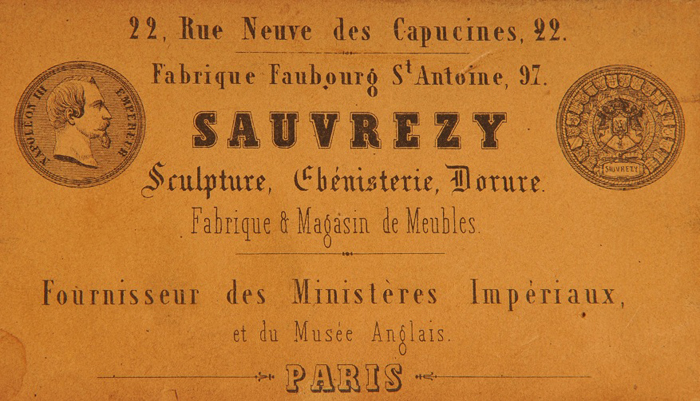
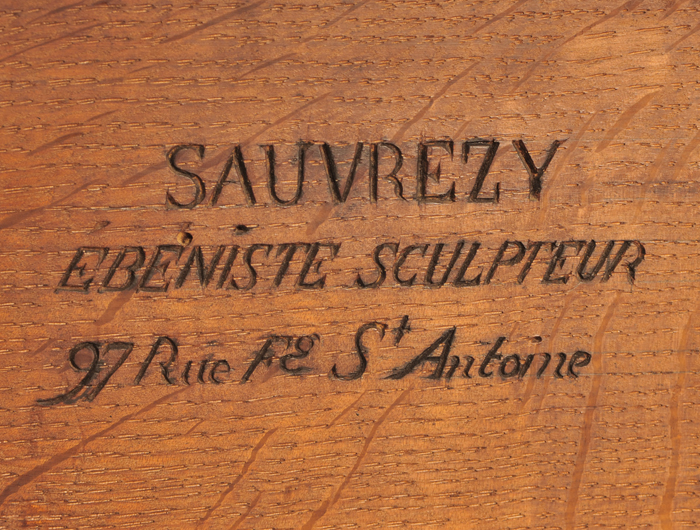
According to trade directories, between 1858 and 1863, Sauvrezy operated a workshop at 97 Rue du Faubourg Saint-Antoine and a shop at 22 Rue Neuve-des-Capucines—located in the Opéra district, an area highly favored by wealthy, fashionable women and connoisseurs from high society.
At the 1878 Exposition Universelle in Paris, he was awarded a gold medal for a Louis XVI-style bedroom suite.
“His name will remain in the memory of all those with a refined taste—those who know how to appreciate a work of art for its true worth, whether ancient or contemporary, and who value the originality, wit, and grace of a piece of furniture. […] Sauvrezy is one of the four or five cabinetmakers of this century who knew how to imbue a desk, a simple chair, a sideboard, or a table with the personal stamp of his own talent—a talent characterized by grace, delicacy, a distinct refinement, and a quality that was tender, feminine, and deeply intimate. Some of his works, through the elegance of their profile and the choice of wood—admirably suited to both the form and the function of the piece—are truly accomplished creations, worthy of the models bequeathed by past centuries. No one interpreted the Renaissance with greater charm, ease, purity, and intelligence than he did.” Revue des arts décoratifs, 3rd year, 1882–1883.
Hippolyte Sauvrezy passed away in Paris in 1883.
See also
Neo-Renaissance style — Renaissance style — Napoleon III style — 1867 World's Fair — 1878 World's Fair