


Style Other / Ref.13481
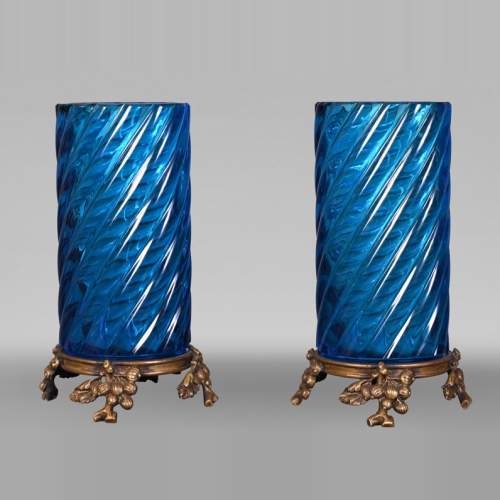
BACCARAT CRISTALLERIE and Eugène ROUSSEAU (model by), Pair of vases « Clair de Lune » in blue crystal and gilt bronze mount, circa 1875-1890
Dimensions
Width: 13 cm / 5'' ⅛
Height: 23 cm / 9''
Depth: 13 cm / 5'' ⅛
diameter: 13 cm / 5'' ⅛
Origin:
19th century.
Status:
Good condition.
This pair of blue crystal vases with hot-enamelled decoration is mounted in a gilt bronze base representing branches of cherry blossom. These vases were produced by the Baccarat crystal works between 1875 and 1890 after a design by Eugène Rousseau (1827-1890). This is the « Clair de lune » (Moonlight) model, whose Japonisant decoration depicts a weeping willow set within a full moon. The neck and the base are highlighted with a fine gilded line.
The two vases are presented on a gilt bronze mount with four feet representing branches of cherry blossom.
François-Eugène Rousseau (1827-1890), known as Eugène Rousseau, was a master glassmaker established from 1855 as a dealer specialising in porcelain and faience in Paris. In 1867, having developed an interest in Japonisant motifs, Eugène Rousseau commissioned Félix Bracquemond to produce a porcelain service intended for display at the Universal Exhibition in Paris, where for the first time a European artist directly copied a Japanese artist, reproducing animal figures from Hokusai's Manga. His Japonisant glassware, produced with the probable collaboration of the Appert brothers at Clichy and the Baccarat crystal works, was presented in 1874 in Paris at the fourth Exhibition of the Union centrale des Beaux-arts appliqués à l'industrie. A member of the Union centrale des Arts décoratifs from its foundation in 1862, Eugène Rousseau was awarded the cross of the Légion d'honneur.
The Baccarat crystal works owes its international renown to its participation throughout the nineteenth century and up to 1937 in the Universal Exhibitions. It was during the nineteenth century that the manufactory distinguished itself in the eyes of the world through the excellence of its production and its constant pursuit of innovation. Its creations long influenced European glass and crystal manufactories and set the standard in terms of technique of execution and stylistic models. The works of the crystal manufactory were very rarely signed before 1860, the year in which the first labels appeared sporadically, and fifteen years later the stamp bearing the name of the crystal works on certain blown models and bronze parts.
Informations
Price: on request
Recommended for you :
Dimensions:
Width: 230
Height: 320
Dimensions:
Width: 14
Height: 28
Depth: 10
Dimensions:
Height: 62
Diameter: 21
Dimensions:
Width: 38
Height: 15
Depth: 20
Dimensions:
Width: 25
Height: 40
Diameter: 50
Dimensions:
Width: 15
Height: 38
Depth: 15
Dimensions:
Width: 9
Height: 17
Depth: 10
Dimensions:
Width: 27
Height: 17
Depth: 23
Dimensions:
Width: 39
Height: 10
Depth: 23
Dimensions:
Height: 32
Diameter: 17
Dimensions:
Height: 25
Diameter: 12
Dimensions:
Height: 33
Depth: 16
Dimensions:
Height: 11
Diameter: 37