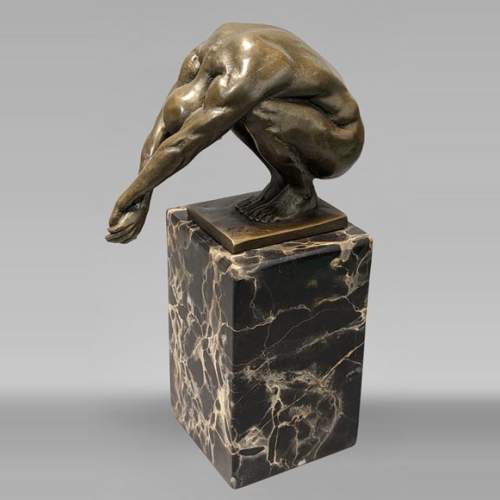
Miguel Fernando Lopez, known as Milo (born in 1955)
Download PDFThe Portuguese sculptor whose signature has become a market trap
Few signatures circulate as widely today as that of Milo, and few raise as many questions. Behind the name stands a very real Portuguese sculptor, Miguel Fernando Lopez, author of a prolific body of small-format bronzes. Around him, however, a trade has grown up in recent castings, produced in series and sold new under the same signature, to the point where the words "signed Milo" no longer tell us, on their own, anything reliable about the author, the date or the value of a piece. This entry separates what belongs to the artist from what belongs to the market.
What is known about the artist
Miguel Fernando Lopez is a Portuguese sculptor born in 1955, who signs his entire output with the studio name Milo. He works with several foundries and produces mainly bronzes of modest dimensions, intended for the domestic interior.
Beyond these facts, caution is required. To date there is no catalogue raisonné, no monograph and no official artist website, and none of his works has been identified in a public collection. The biographical notes found online — birth in Lisbon, an antique-dealer father, studies in sculpture, anecdotes from his youth — all derive, on examination, from a single text of commercial origin, reproduced from site to site. In the absence of any independent source, these details cannot be regarded as established.
Milo's working model, on the other hand, can be read clearly in his work: it belongs to the world of the edition rather than the unique piece. This places him within a tradition dating back to the nineteenth century, of which the Maison Barbedienne was the most accomplished French example: making sculpture accessible through the controlled multiplication of casts.
The work: subjects and style
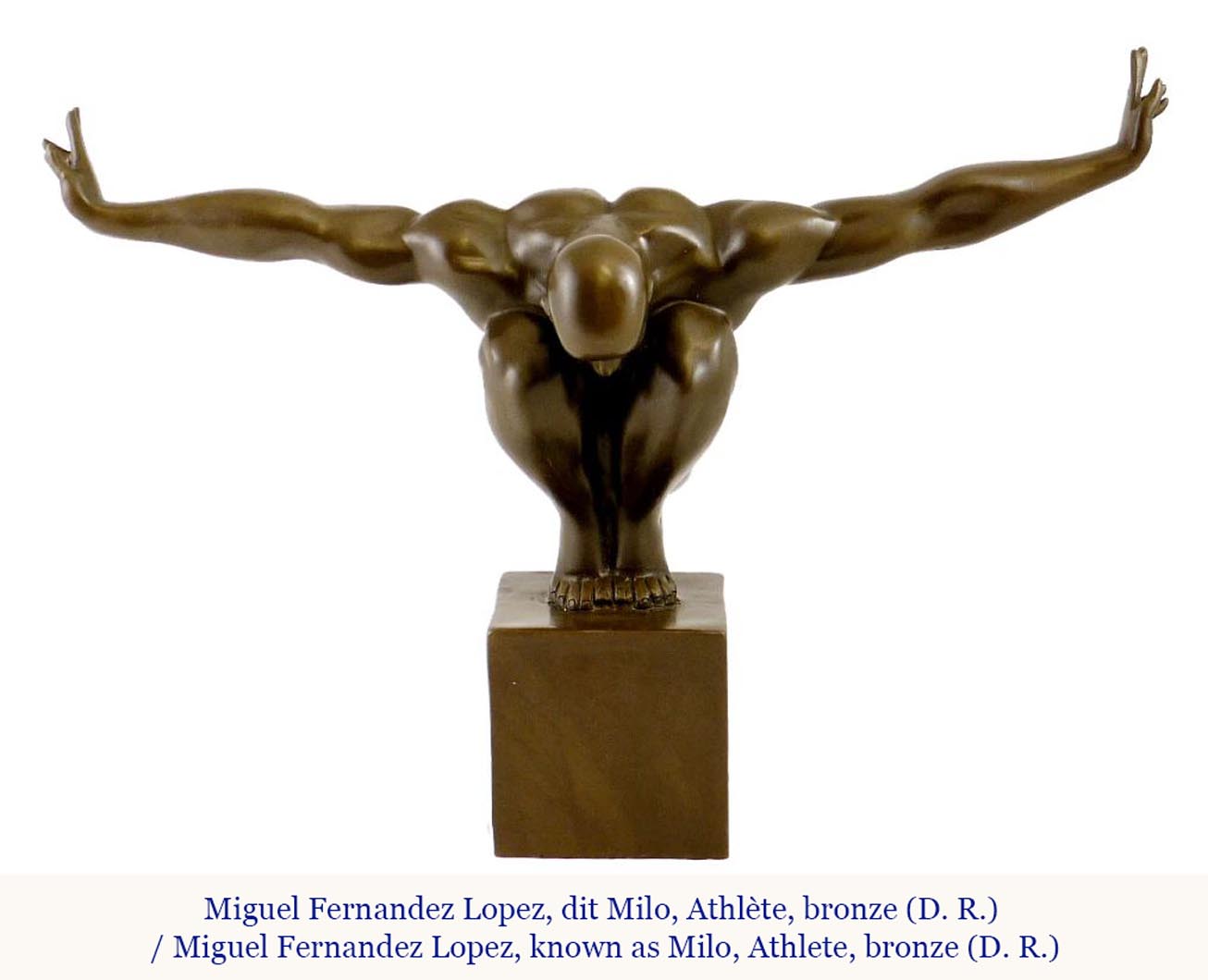
Milo's repertoire falls into three families. First, the female nude, shown reclining, seated or twisting, often set on a black or veined marble base. Next, the athletic body — divers, athletes, rugby and polo players — in which the artist focuses on muscular tension and the suspended instant before movement. Finally, animals, horses, bulls, owls and elephants, handled with a stylisation that owes much to the animalier sculpture of the 1930s.
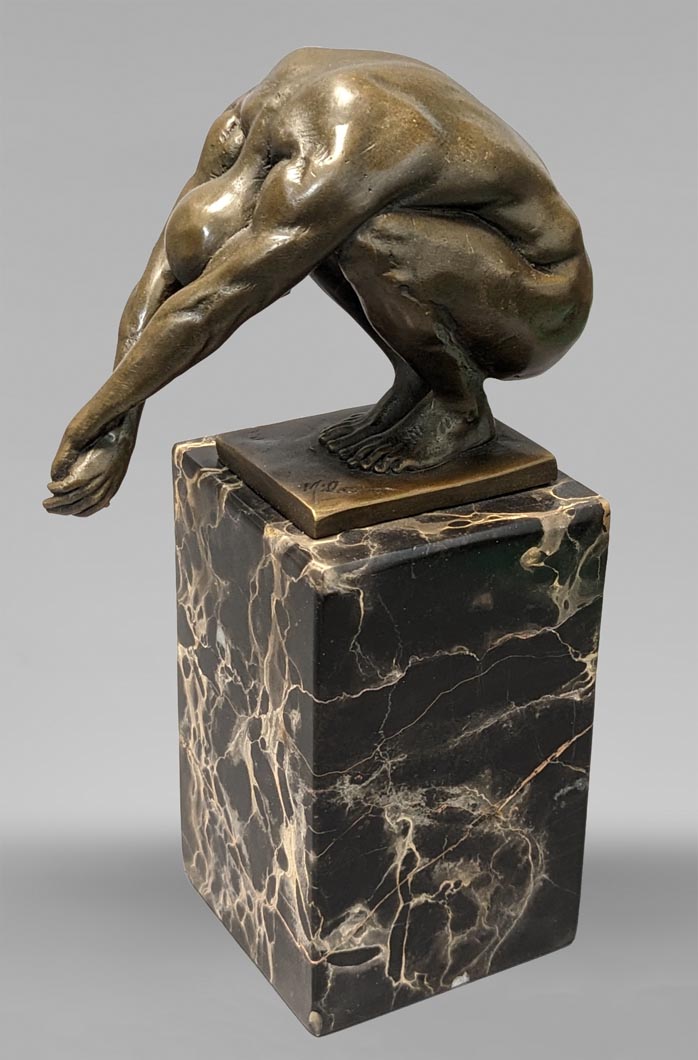
One constant runs through these subjects: an interest in the suppleness of the body and the torsions it can undergo. The compositions favour the elegance of the curve over documentary accuracy. In The Diver, for example, the pose is not strictly that of a diver — who would point his hands towards the water — but a harmonious interlacing of the arms, chosen for the line it draws. The patina, usually brown or with green nuances, and the marble base, often of Portor or black marble, are an integral part of the intended effect.
One name, several confusions
Several homonyms and misattributions cloud any search, and it is worth setting them aside from the outset.
The Venus de Milo, the Greek statue in the Louvre, obviously has nothing to do with him: Milo there refers to the island of Milos. Milo Baughman was an American furniture designer of the twentieth century. There are also animalier bronzes from the early twentieth century signed Milo and bearing Parisian foundry stamps: these predate our sculptor's birth and are the work of another hand.
The confusion extends even to public auctions. Lots attributed to Milo have been described as French bronzes, others as Spanish, and others catalogued only as "in the style of" the artist. Milo is Portuguese, and these hesitations show how fragile attribution remains.
The market in recent castings
This is the point every buyer needs to understand. A considerable share of what is sold today as a "bronze signed Milo" consists of recent castings, produced in series, unnumbered and sold new by home-decoration websites, at advertised prices generally between one hundred and six hundred euros. These objects are frequently described as originals while being presented elsewhere, by the same sellers, as reproductions — a contradiction that should in itself raise suspicion.
A second phenomenon adds to the first: clearly Art Deco models, dancers and draped women in the taste of the 1920s, bear the Milo signature even though they reproduce compositions from well before his time. These are modern castings in a period style, not works from the interwar years.
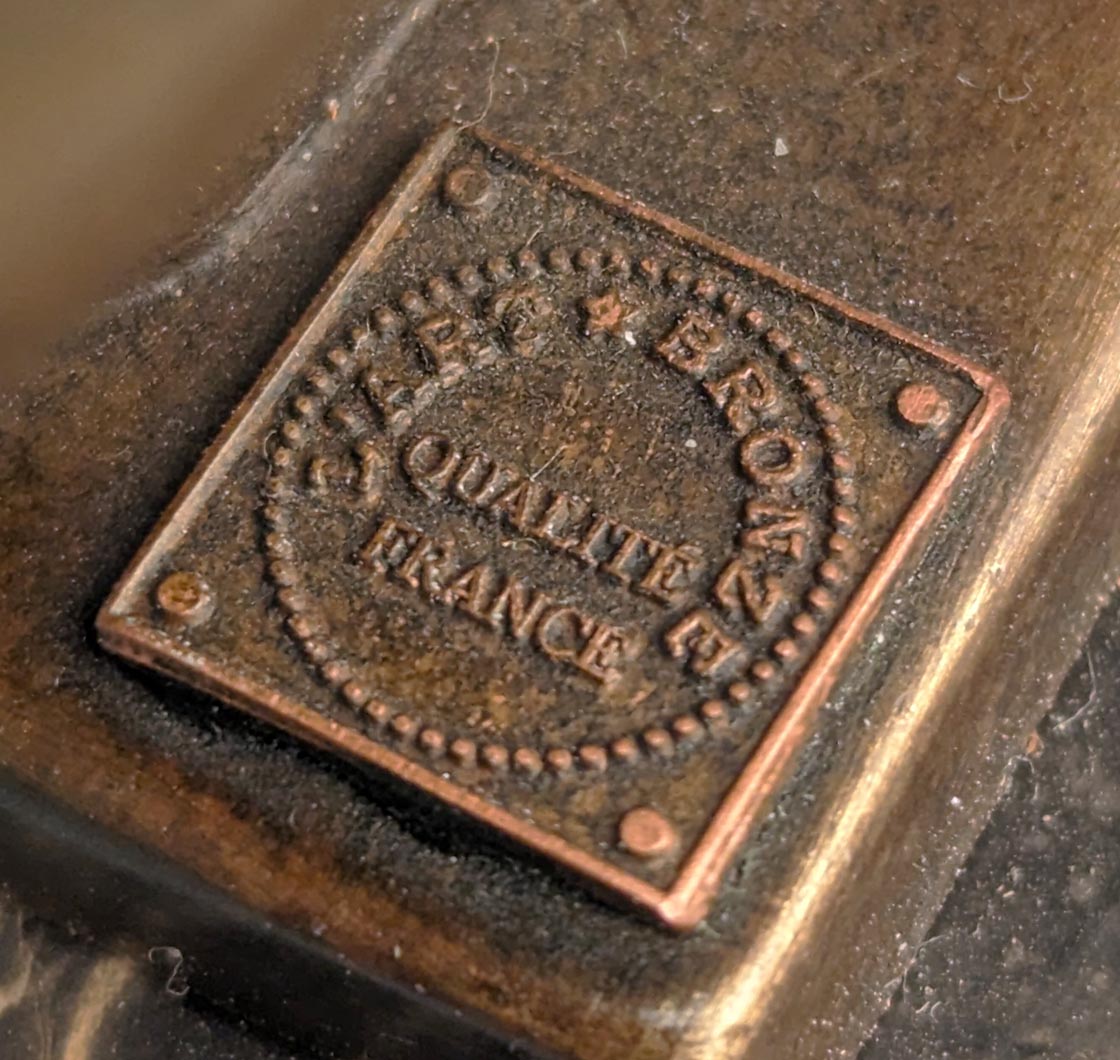
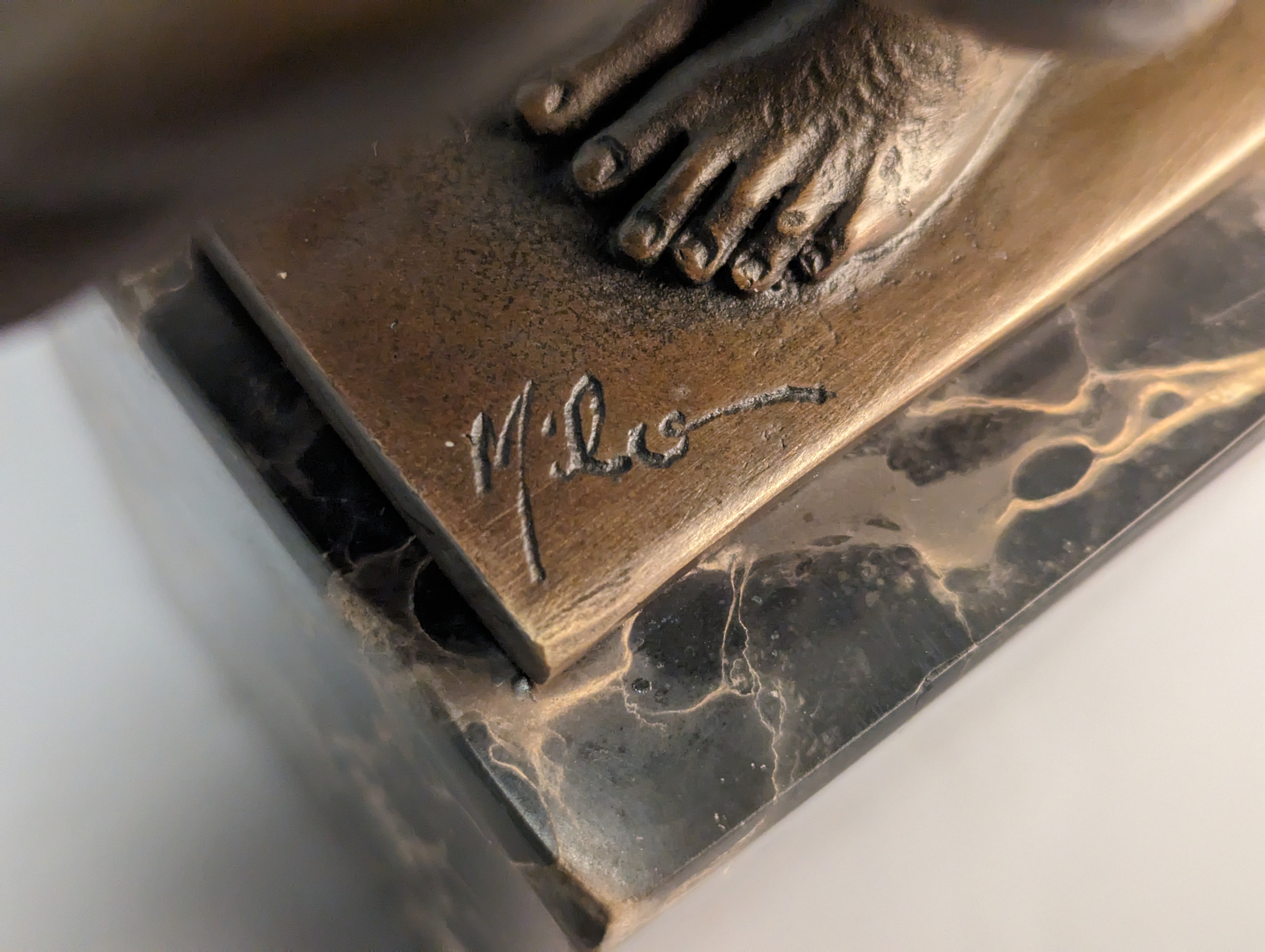
Finally, collectors have long observed that the form of the signature varies noticeably from one piece to another. This variability, which may have legitimate causes — several foundries, several decades of production — makes it impossible to authenticate a piece on the signature alone.
Identifying and valuing a bronze signed Milo
In the absence of a catalogue raisonné and of any systematic numbering of editions, assessment rests on a body of evidence rather than on a single proof. These are the indicators that matter.
The material before the signature. First check that the piece is indeed bronze and not spelter — a zinc alloy that is much lighter, colder to the touch, gives a dull sound, and shows grey rather than the yellow of bronze where it is chipped or broken. Many pieces sold as bronze are nothing of the kind. For the same volume, bronze is noticeably heavier.
The quality of the casting. A careful casting preserves fine detail: separated fingers, crisp edges, legible hair. Series castings made by aftercasting — that is, from a mould taken from an existing cast rather than from the original model — lose sharpness, become rounded, and are often slightly smaller than the original owing to the shrinkage of the metal. Examine the inside of the base as well: coarse mould seams and traces of hasty grinding betray rushed production.
The patina. An old chemical patina shows subtle variations and wear consistent with the points of handling. A recent patina, often applied cold, flakes at the edges and reveals a bright, uniform metal beneath.
The base. The marbles used, their thickness, the finish of the edges and the method of fixing often say more than the sculpture itself.
Provenance. This is the decisive criterion. A piece bought new from a general marketplace, with no original invoice or history, will remain a decorative object whatever its signature. A documented piece, accompanied by a gallery invoice or a record of ownership, belongs in a different category.
A place in the history of the editioned bronze
The Milo case sheds light on a broader question that has run through the history of sculpture since the nineteenth century: that of the multiple original. When Ferdinand Barbedienne published reductions of antique sculptures using the Collas process, or when the Val d'Osne foundry distributed the models of Mathurin Moreau, the question of authenticity already arose — and it was settled by the rigour of the publisher, control of the edition size and the presence of identifiable foundry marks. These are precisely the guarantees missing from much of the output circulating today under the Milo signature. The artist is not responsible for this; the buyer must take it into account.
See also
Ferdinand Barbedienne — The Val d'Osne Foundry — Mathurin Moreau — Christophe Fratin — Spelter — Gilt bronze — The Art Deco style
Bibliography
Note. At the time of writing (September 2026), there is no catalogue raisonné, monograph or official website for Miguel Fernando Lopez, and none of his works has been identified in a public collection. The only structured sources available are auction databases, which record verifiable sale results.
Auction results
- artnet, "Miguel Fernando Lopez (Milo)", auction results database: artnet.com/artists/miguel-fernando-lopez-milo
- MutualArt, "Miguel Fernando López (Milo)", auction results database, more than a thousand lots recorded since 2012: mutualart.com
- askART, "Miguel Fernando Lopez": askart.com
- Bukowskis, Stockholm, online sale 2021, Mare and Foal — auction record for the artist (USD 2,980), as recorded by MutualArt.
Biographical notes
The biographical notes published by these same databases and by various resellers reproduce a common text of commercial origin. They have not been used as sources for biographical information, with the exception of the year of birth and nationality, which are consistent across sources.
Gallery sources
- Galerie Marc Maison, inventory records and workshop observations on bronzes by the artist that have passed through its hands.