Christophe Fratin
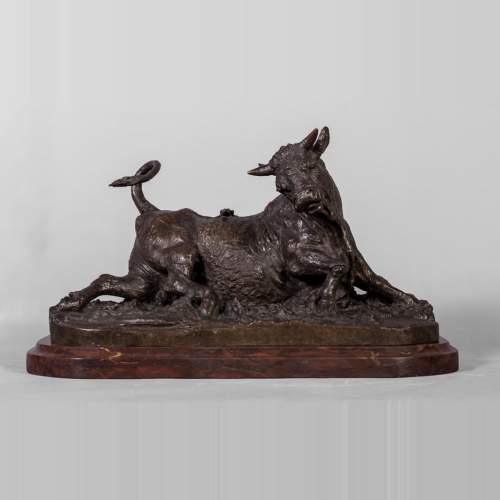
Download PDFBorn in Metz in 1801, Christophe Fratin began his studies in drawing at a very young age. Upon arriving in Paris, he continued his training under Carle Vernet and Théodore Géricault. At the age of thirty, he participated in his first Salon of painting and sculpture at the Academy of Fine Arts—an event in which he would continue to exhibit until his death. His sculptures achieved great success during the 1830s. This accomplishment was partly due to the long hours Fratin spent in his father’s taxidermy workshop; this early exposure to animals allowed him to master their anatomy. Consequently, he established himself as a leading figure in the French school of animal sculpture, alongside artists such as Auguste Caïn (1821–1894), François Pompon (1855–1933), and Antoine-Louis Barye (1796–1875). The latter had caused a sensation at the 1831 Salon with his work Tiger Devouring a Gavial. This naturalist movement remained highly regarded throughout the 19th century. As a result, Fratin received numerous commissions, both within France and internationally. He enjoyed significant success in England, which he visited between 1833 and 1834; his works were even exported to America and as far as Saint Petersburg, where they were commissioned by Emperor Nicholas I.
His many depictions of Dancing Bears, as well as his numerous portrayals of horses or animals engaged in human-like activities, place Christophe Fratin within the Romantic movement—a tradition that sought out the exotic, the fantastical, and the enchanting. It is also worth highlighting the great sense of humor that characterizes the sculptor, which is evident in the wealth of picturesque details found throughout his works. This aspect of his art most distinguishes him from his rival, Antoine-Louis Barye, who was known for a more tragic and violent depiction of the animal kingdom.
Fratin worked closely with Parisian foundries, allowing him to oversee the production of his pieces; he was, in fact, a pioneer in the field of commercial sculpture editions. Over the course of his career, he collaborated with various bronze founders: the Susse brothers in the 1830s, the Quesnel workshops from 1840 to 1847, and, toward the end of his career, the founder Daubire.
In the 1840s, Christophe Fratin began producing small-scale models that proved highly popular. During the 1850s, he secured several public commissions, including The Two Eagles Guarding Their Prey (1853) for the Esplanade in Metz, and The Hunt (1855)—a pediment created for the Cour Visconti at the Louvre Palace.
Toward the end of his life, Christophe Fratin organized sales of his bronze models, including the associated reproduction rights—a practice he continued until his death on August 17, 1864, in Le Raincy (Seine-et-Oise).
Works by Christophe Fratin can be found in numerous collections, including those of the Louvre Museum, as well as institutions in Metz, Lyon, and Nîmes, and the Wallace Collection in London.
Bibliography
- Kjellberg, Pierre, Les bronzes du XIXe siècle, Dictionnaire des sculptures, Paris, Les Éditions de l'Amateur, 1987.
- Lami, Stanislas, Dictionnaire des sculpteurs de l'École française au dix-neuvième siècle, Vol. II, Paris, 1916 (Klaus reprint, 1970).
- Bongon, Jacqueline, Le sculpteur animalier Christophe Fratin, Essai sur sa vie et son œuvre, Le Raincy [no publisher indicated], 1983.
- Poletti, Michel; Richarme, Alain, Inventaire des œuvres de Fratin, Paris, Éditions Univers du Bronze, 2000.