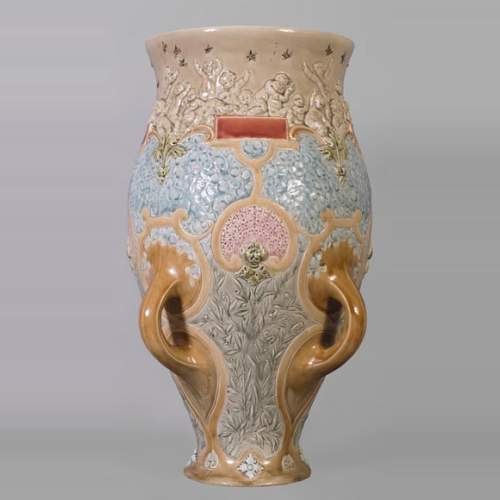
La manufacture de Choisy-le-Roi
Download PDFFor more than a century, the Choisy-le-Roi faience works, in the Val-de-Marne, was one of the most important earthenware manufactories in France. Founded in 1804 on part of the former royal estate, it became under the Boulenger family an industrial empire: table services sold around the world, monumental art pieces, cladding panels for façades and Métro tiles. It sustained thousands of the town's families until its closure in the 1930s.
The Paillart brothers (1804-1836)
The manufactory was founded by the three Paillart brothers — Valentin, Melchior and Nicolas — who bought on 11 May 1805 (21 Floréal, Year XIII) a four-hectare plot on part of the former buildings of the royal château; the date of 1804, retained by tradition, is carved on the entrance gate. Until 1824 the Paillarts owned the works. Valentin Paillart then ran it with his partner Hippolyte Hautin.
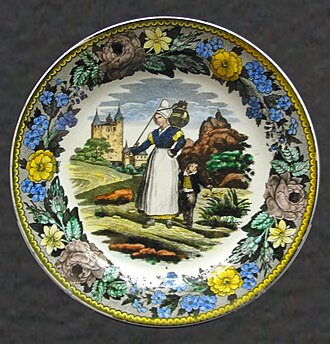
The manufactory made fine earthenware, a process brought from England that imitates porcelain, and very early practised transfer printing of decoration on earthenware, from 1808 according to some sources.
The Boulenger family
In 1836 Paillart withdrew: Hautin went into partnership with Louis Boulenger, whose family would run the manufactory until its closure. In 1863 his son Hippolyte Boulenger (1836-1892) became sole owner. In 1878 the business was turned into a joint-stock company, the Société Hippolyte Boulenger et Compagnie, and its workshops were enlarged. Hippolyte died in 1892; the management passed to his successors in the family.
The works employed about 300 people in 1860, 1,300 in 1900 and up to 1,400 in the 1930s. Around 1880 output reached about 300,000 pieces a week.
A production with two faces
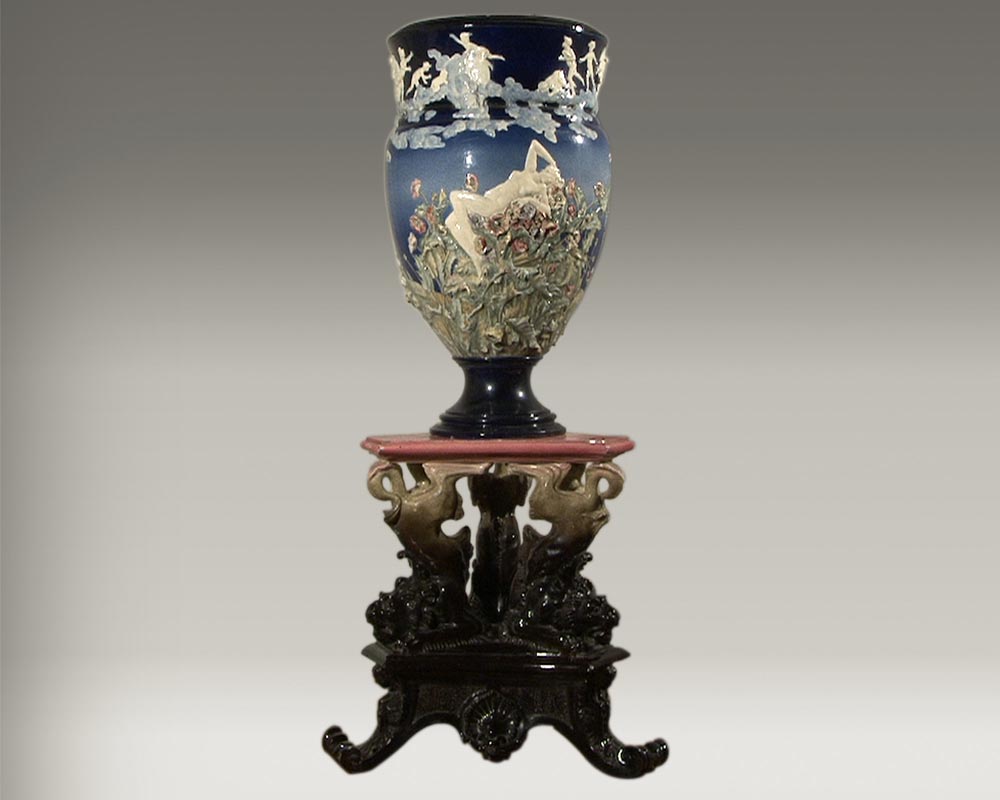
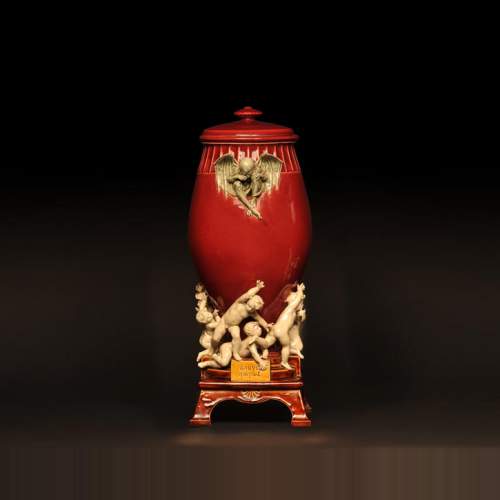
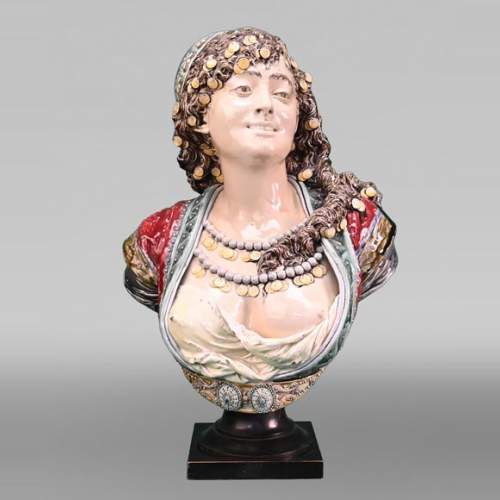
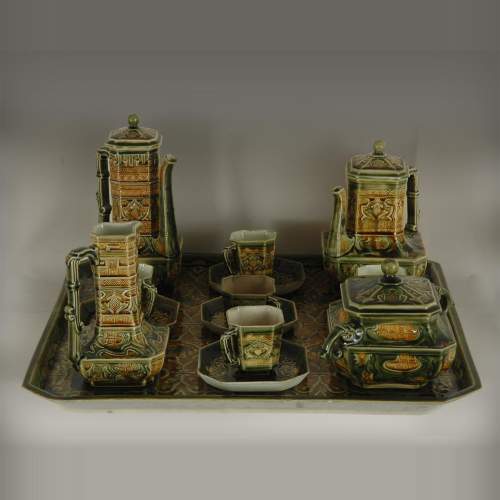
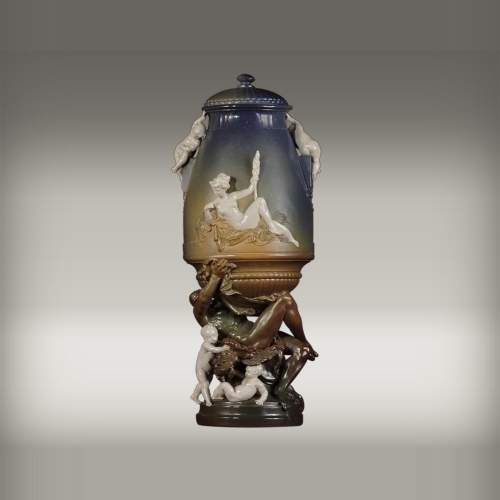
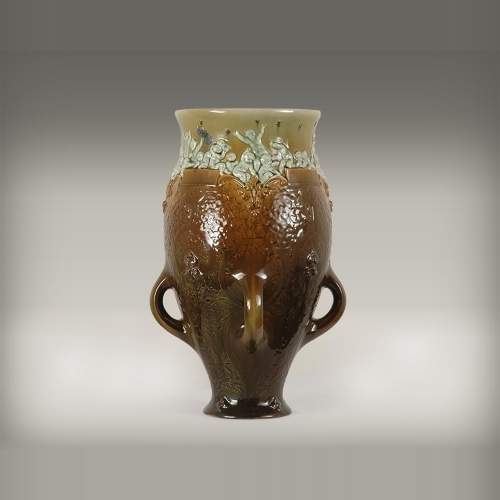
The manufactory had two complementary activities. On one side, everyday production: tableware, tea and coffee services, sanitary ware and vases, sold in France and abroad. On the other, art pieces, sometimes monumental, for wealthy collectors and shown at exhibitions from 1867. The repertoire was wide: services with themed series, rebus plates and advertising plates, miniature dolls' services, Palissy-inspired dishes, funerary art, clock cases.
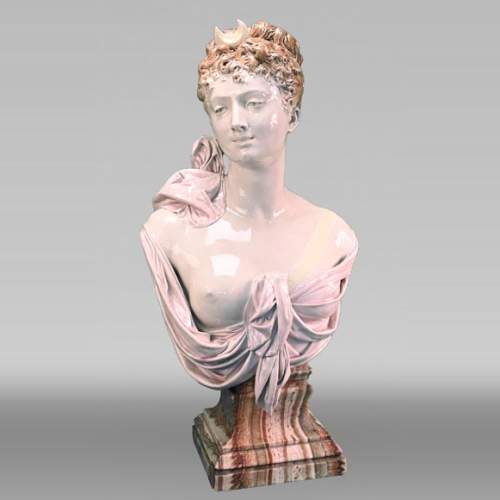
The sculptor Louis-Robert Carrier-Belleuse (1848-1913), son of Albert-Ernest Carrier-Belleuse, worked for the manufactory, of which he was artistic director from 1889: he made busts and vase models there, such as the stoneware vase Uranie, shown at the 1902 exhibition.
Architectural ceramics
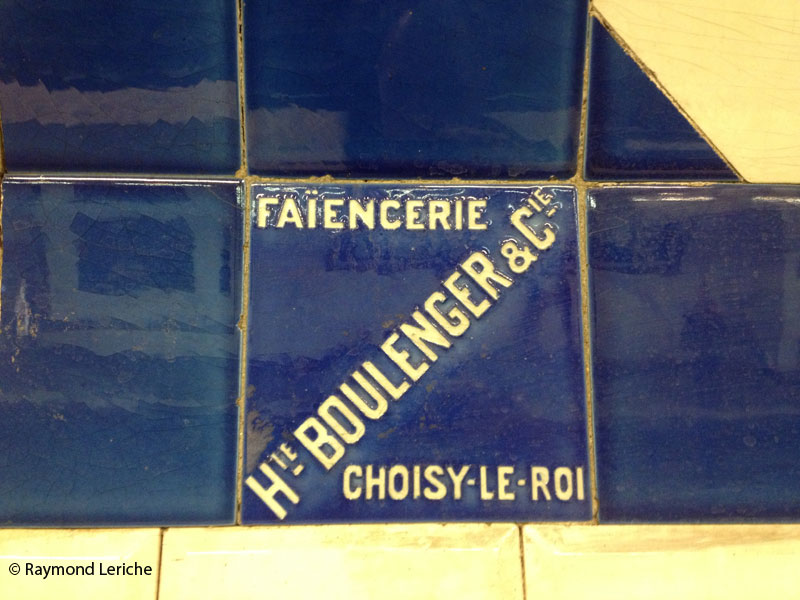
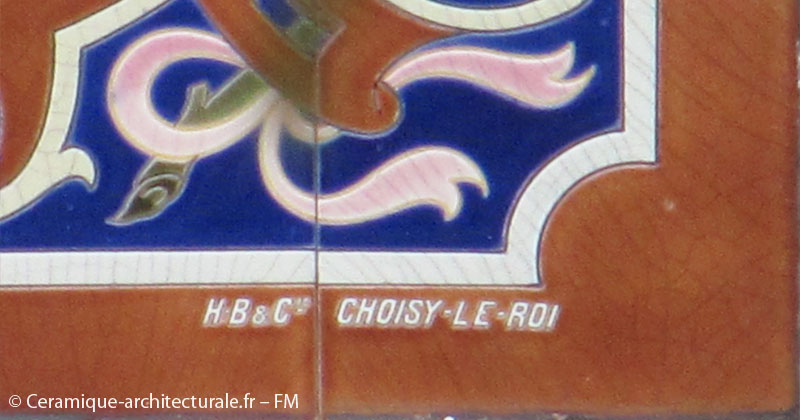
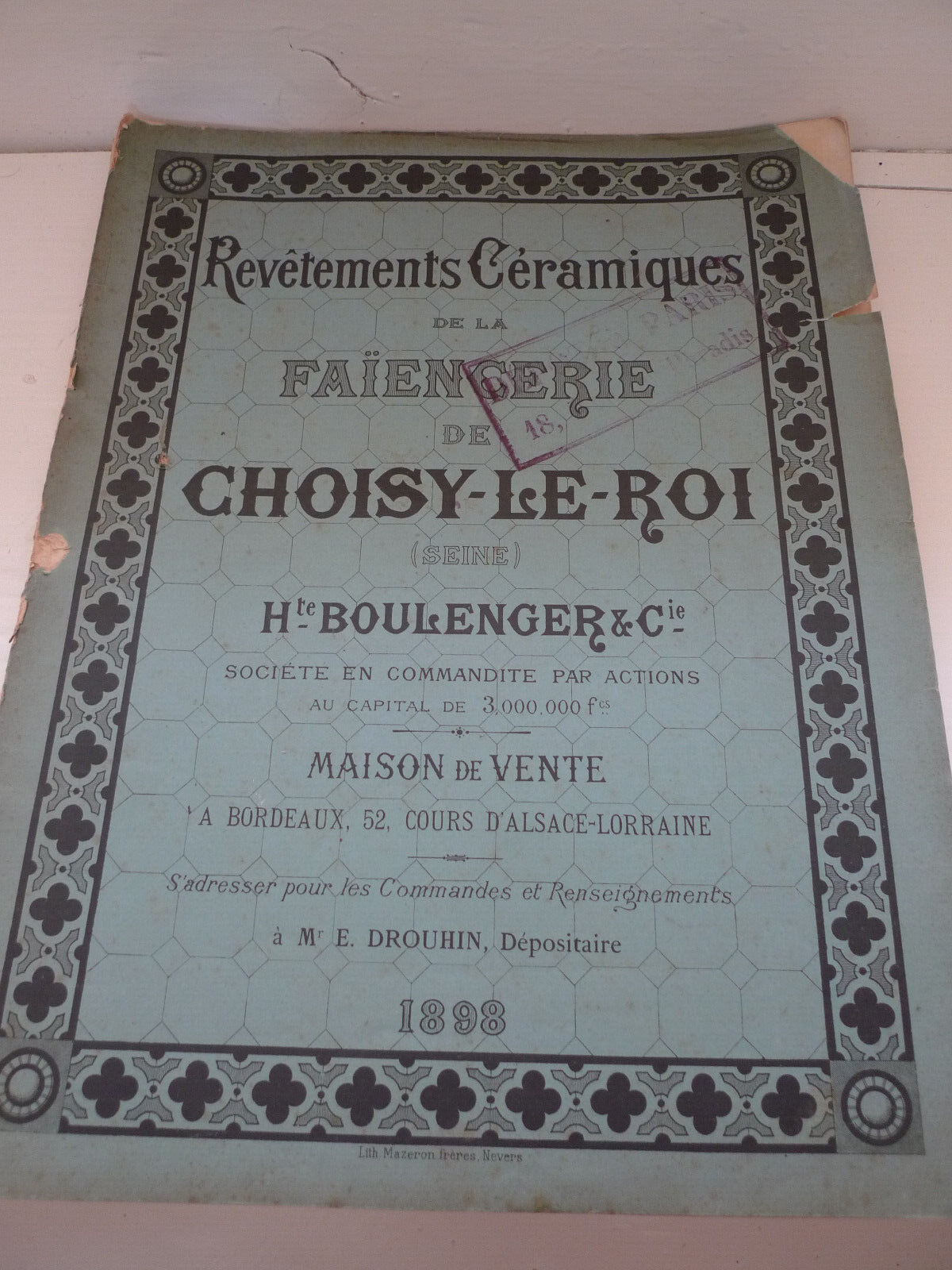
From 1878, new workshops were devoted to art ceramics and to architectural decoration in cloisonné enamels. The Boulenger firm supplied façade panels, friezes and cladding, some of which bear its name: the inscription H-B & Cie Choisy-le-Roi appears on panels with motifs recombined from its late-nineteenth-century catalogues.
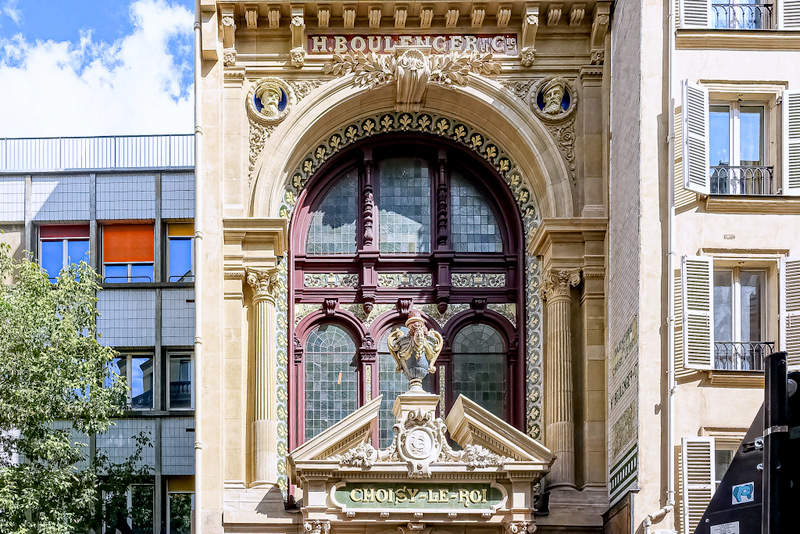
Its Paris head office was itself a showcase. In 1889, Paul Boulenger commissioned the architects G. Jacottin and Ernest Brunarius to build the new head office at 18 rue de Paradis, Paris, a warehouse and showroom whose façade and courtyards are covered in the firm's tiles, mosaics and panels. The large compositions in the passage are mostly attributed to the painter and ceramicist Alexandre-Joseph Arnoux, who headed the decoration workshop. The building, which in the twentieth century housed the Musée de l'Affiche, now houses a school.
The Métro tiles
The Boulenger firm is forever linked to an object of everyday life: the white bevelled tile of the Paris Métro stations. It supplied about two thirds of them at the opening of the first line in 1900, sharing the market with the Gien faience works. Around 1930, nearly 200,000 tiles came out of the Choisy kilns every week.
A town of faience makers
At the end of the nineteenth century the Boulenger family owned about a third of the territory of Choisy-le-Roi, including the château. It ran a social policy there: crèche and asylum (1867), boys' school (1872), brass band (1875), apprentice boarding school (1883), savings bank, mutual aid society and food cooperative. From the 1880s it built the Gondoles district and the "Villa des faïenciers", on the model of Émile Müller's workers' estate in Mulhouse. Several streets in the town are named after faience makers.
Marks
According to the town of Choisy-le-Roi, the marks changed with the owners: an incised star from 1804 to 1823, an incised escutcheon from 1824 to 1835, H & B (Hautin and Boulenger) from 1836 to 1863, H·B from 1863 to 1878, then Hte Boulenger & Cie from 1878.
Closure and legacy
In the 1920s the group bought the Creil and Montereau manufactories and took the name H.B.C.M. But difficulties accumulated: strikes broke out in 1936; the Choisy workshops closed for good in the 1930s (1934, 1936 or 1938 depending on the source). Those at Montereau continued until 1955. The Choisy buildings were demolished from 1952, and a commercial slab now occupies the site. The wall-covering company founded under the name Établissement Boulenger in 1967 still exists, according to the Musée d'Orsay.
The Musée d'Orsay holds a Dish from the "Grands oiseaux" service from the manufactory, about 1890-1894. Many houses in the town still bear faience decoration, and the Métro tile perpetuates the memory of Choisy.
See also
The Faïencerie de Gien — Émile Müller — Art Nouveau — The 1889 Exposition Universelle — The 1900 Exposition Universelle — Louis-Robert Carrier-Belleuse and the Faïencerie de Choisy-le-Roi: "Uranie", stoneware vase exhibited in 1902
See our ceramics, faience and porcelain
Bibliography
Institutional sources
Town of Choisy-le-Roi, municipal archives department, La faïencerie Hippolyte Boulenger et Cie, Choisy-le-Roi, 1804-1936, brochure, December 2005 (online at choisyleroi.fr).
Town of Choisy-le-Roi, "La faïencerie Boulenger", Heritage section, choisyleroi.fr.
Musée d'Orsay, Paris, entry "Boulenger et Cie" (no. 4976) — history of the manufactory; Dish from the "Grands oiseaux" service, about 1890-1894.
Studies and articles
Association Louis Luc, La faïencerie de Choisy-le-Roi (1804-1938), Choisy-le-Roi, 1999 (Cahier no. 5).
Hélène BOUGIE, master's thesis on the Choisy-le-Roi faience works, Université Paris XII, 1982; DEA thesis, École des hautes études en sciences sociales, 1986 (Choisy-le-Roi municipal archives).
Claude FRANK, "La fine faïence de Choisy-le-Roi", Antiquités Brocante, no. 138.
Françoise MARY, "Les panneaux marqués de la Faïencerie de Choisy-le-Roi", ceramique-architecturale.fr, 2013 (updated 2015).
Manufactory catalogues
Revêtements céramiques Hte Boulenger & Cie : faïencerie de Choisy-le-Roi et tuilerie de Vitry-sur-Seine, catalogue, 1898 (digitised on the Internet Archive).