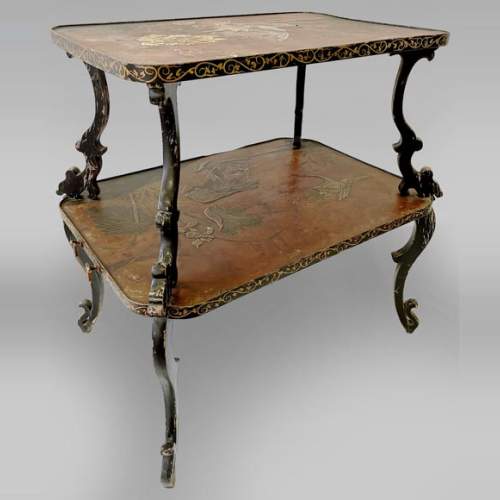
Louis Majorelle (1859-1926)
Download PDFLouis Majorelle is, with Émile Gallé, one of the great figures of the École de Nancy and one of the most important French cabinetmakers of Art Nouveau. Heir to a family furniture and faience business, he turned a firm making period-style furniture into a modern house producing pieces in which carved wood follows the forms of plants and gilt bronze becomes an integral part of the furniture. His career was hit hard by the First World War, then resumed in an Art Deco language.
A family workshop
Louis Majorelle was born in Toul on 26 September 1859. His father, Auguste Majorelle (1825-1879), a furniture designer and manufacturer, founded the family firm, which moved to Nancy in the early 1860s. Louis studied at the École des Beaux-Arts in Nancy, then in Paris from 1877, in the studio of the painter Aimé Millet.
His father's death in 1879 cut short his studies: he returned to Nancy to run the factory with his mother and his brother Jules, from the rue Saint-Georges shop. He became its artistic director in 1884. He married Marie Léonie Jane Kretz in 1885; their son Jacques Majorelle, born in 1886, became a painter. His early output was that of his time: period-style furniture inspired by the 18th century, and pieces with a Japanese flavour. A silver medal at the Paris Exposition Universelle of 1889 marked this first stage.
The turn to Art Nouveau
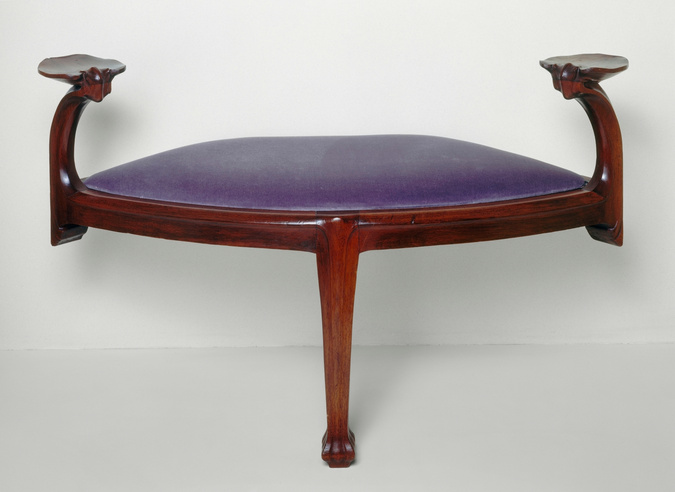
In the 1890s Majorelle opened a metalwork workshop (1890), then turned to marquetry decoration with naturalist and symbolist motifs (1894). The influence of Émile Gallé, who steered him towards decoration inspired by nature, was decisive. Like Gallé, he based the structure of the furniture — legs, uprights, crosspieces — on the outlines of plants, with more curved profiles. The Musée d'Orsay stresses this in connection with his famous corner banquette of 1900 (see below).
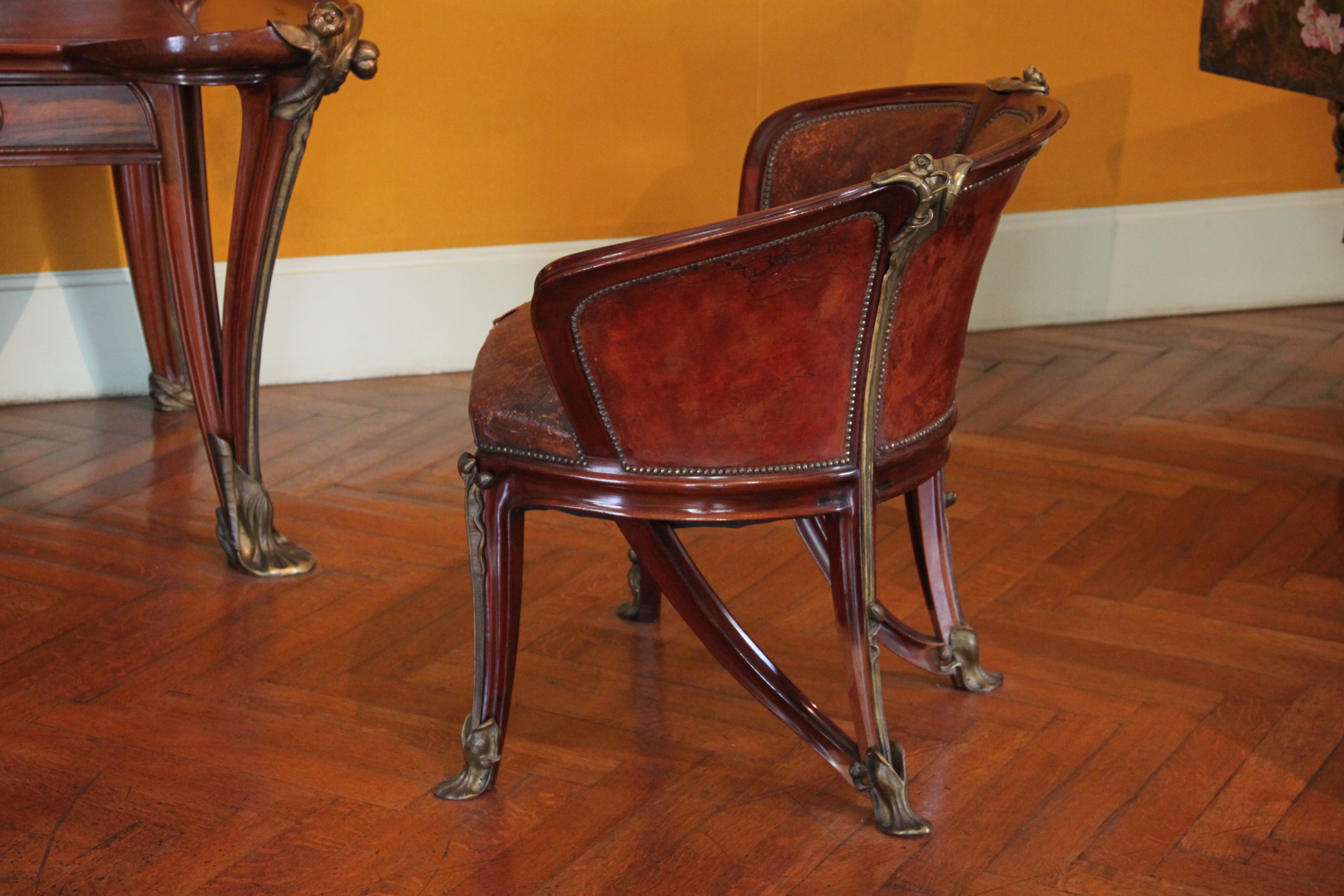
His best-known models bear the names of plants, among them the Aux Nénuphars (water lily) furniture shown at the 1900 Exposition Universelle, where he also sat on the jury. The gilt bronzes that protect the corners and form the handles carry the plant motif into the metal.
The firm produced both luxury furniture made in Nancy and more affordable pieces made in series at Bouxières from 1905. Showrooms were opened in Paris, Lyon, Lille, Oran and Algiers. In 1897 Majorelle built new workshops on the rue du Vieil-Aître. From 1898 he collaborated with the Daum house on lighting, and with Henri Sauvage on the Café de Paris in Paris.
The Villa Majorelle and the École de Nancy
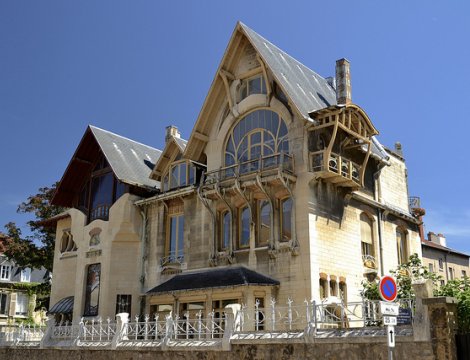
In 1901-1902 Majorelle had his house and studio built by the young architect Henri Sauvage, assisted by Lucien Weissenburger. The Villa Majorelle is a collective work: Majorelle produced the furniture, ironwork and woodwork, Jacques Gruber the stained glass, Alexandre Bigot the facade ceramics and the dining-room fireplace, and Francis Jourdain contributed to the furniture and painted the frieze of birds in the dining room. It has been protected as a historic monument since 1975.
In 1901 Majorelle was one of the founders of the École de Nancy (Alliance provinciale des industries d'art) and one of its vice-presidents. There he rubbed shoulders with Gallé, the Daum brothers, Gruber, Eugène Vallin and Victor Prouvé. The patron Eugène Corbin, owner of the Magasins Réunis in Nancy, commissioned furniture from him for his summer residence Les Eaux Bleues at Liverdun, for which the 1900 corner banquette now in the Musée d'Orsay was made; the house today shelters the Musée de l'École de Nancy.
1916 and the post-war years
The war struck Nancy hard. In 1916 the factory on the rue du Vieil-Aître and part of the villa were destroyed or badly damaged, along with the firm's drawings, moulds, awards and archives; in 1917 the rue Saint-Georges shop was destroyed by bombing. Majorelle moved to Paris, returned to painting at the Académie Julian and made cloisonné glassware with Antonin Daum, before rebuilding his Nancy workshops.
After the war he reopened his factory and shops. The style had changed: the plant curves gave way to a tauter geometry that ties his last works to Art Deco.
Louis Majorelle died in Nancy on 15 January 1926. His brother Jules took over the management of the firm, and Alfred Lévy directed its design. The rue Saint-Georges shop closed in 1951; the workshops ceased trading in 1956 according to the Musée de l'École de Nancy (some sources give 1931 for the closing of the factories).
Legacy
The family could not keep the villa after Majorelle's death: the house was sold, then occupied by offices of the Ponts et Chaussées administration and heavily altered. It now belongs to the City of Nancy, which opens it to visits. The villa's bedroom suite, acquired in 1982, is kept in the Musée de l'École de Nancy, which holds an important group of his furniture, including the Aux Nénuphars armchair. The Musée d'Orsay also holds his 1900 corner banquette.
See also: Émile Gallé — Art Nouveau — Victor Horta — Hector Guimard — Japonisme — Art Deco style — Gilt bronze
Bibliography
Institutional sources
Musée de l'École de Nancy, Nancy, "The protagonists of the École de Nancy: Louis Majorelle" (biography and chronology of the Majorelle firm).
Musée d'Orsay, Paris, Corner banquette, 1900, varnished walnut, OAO 331, from Les Eaux Bleues, Eugène Corbin's residence at Liverdun.
Marc Bascou, Marie-Madeleine Massé, Philippe Thiébaut, Musée d'Orsay. Catalogue sommaire illustré des arts décoratifs, Paris, Réunion des musées nationaux, 1988, p. 169.
Online resources
"Louis Majorelle" and "Villa Majorelle", Wikipedia (English version).