François-Désiré Froment-Meurice (1802-1855)
Download PDFFrançois-Désiré Froment-Meurice, born in Paris in 1802 (some sources give 1801) and died in Paris on 17 February 1855, is one of the most renowned Parisian goldsmiths and jewellers of the 19th century. Drawing on the Middle Ages and the Renaissance, his work combines silver, gold, enamel and hardstones in a resolutely Romantic spirit, making him a leading figure of historicist silverwork.
A family workshop
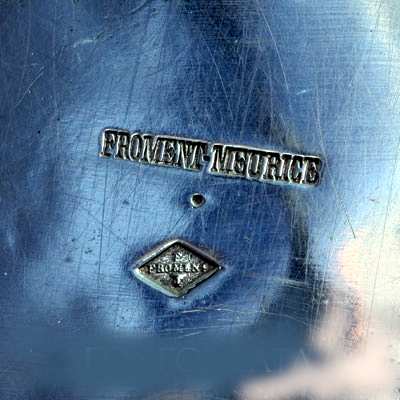
The son of the goldsmith François Froment, he took the name Froment-Meurice. From 1832 he ran the family workshop, developing it into a firm of the first rank. His maker's mark, reading "F/FROMENT" with a sheaf of wheat, was registered in 1833, as seen on a piece in the Metropolitan Museum of Art. He was appointed goldsmith-jeweller to the City of Paris.
His workshop was first near the Hôtel de Ville, then moved after 1848 to the Madeleine quarter, on the rue du faubourg Saint-Honoré, where the firm kept its showrooms under the Second Empire.
A Romantic style between the Middle Ages and the Renaissance
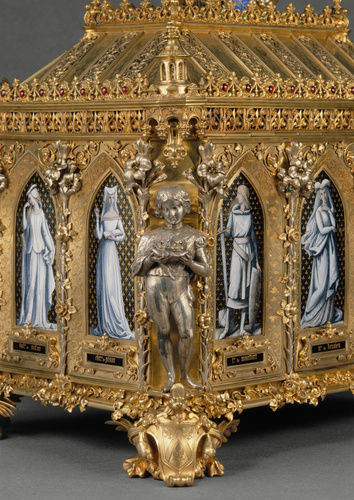
Froment-Meurice drew extensively on Renaissance models and the Gothic imagination, combining sculpted figures, polychrome enamel, coloured stones and chased ornament. He worked with sculptors and designers of his day to create pieces of strong relief. The Metropolitan Museum describes him as a master of silver gilt working in historicist styles drawn from medieval, Renaissance and Islamic sources; its basin of about 1850, with a trellis and flower-head pattern, is an exception through the restraint of its lines.
His friends and clients included writers: Victor Hugo, Théophile Gautier and Balzac admired his art. A well-known ornamented cane is associated with Balzac, its decoration said to have been designed by the sculptor Pierre-Jules Cavelier.
Major exhibitions and the toilet service of the Duchess of Parma
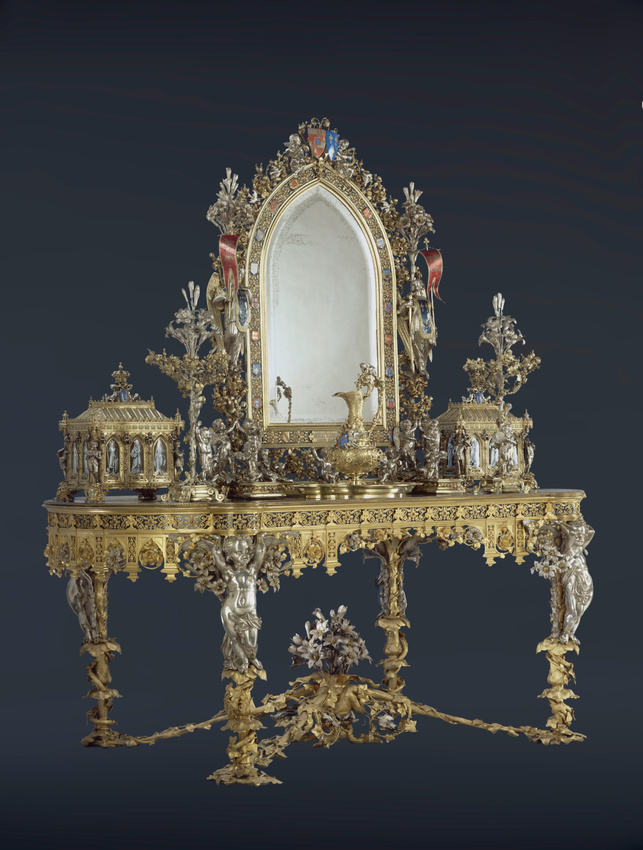
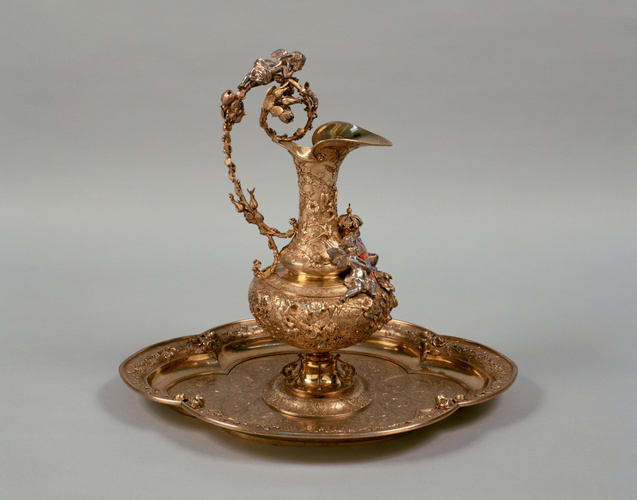
His career was marked by successes at the industrial exhibitions: medals from 1839, then a gold medal in 1844. He exhibited in London from 1849, then elsewhere in Europe. His most famous masterpiece is the toilet service of the Duchess of Parma, commissioned in 1845 by Legitimist ladies for the marriage of Louise-Thérèse de Bourbon and shown at the Great Exhibition in London in 1851. The Musée d'Orsay holds several elements (basin, mirror, table, candelabra and caskets, about 1847), as well as Patria (1854).
After 1855
Froment-Meurice died in February 1855, a few months before the Paris Exposition Universelle. His widow and his son Émile Froment-Meurice (1837-1913) prepared his exhibits, and the firm received a Medal of Honour. Émile continued the workshop under the Second Empire and beyond, producing among other works the bronze and silver decoration of the cradle of the Prince Imperial (1856, Musée Carnavalet).
Where to see his work
Besides the Musée d'Orsay, his creations are held by the Victoria and Albert Museum, London (an agate, silver-gilt, enamel and ruby box acquired at the 1855 Paris Exhibition) and the Metropolitan Museum of Art, New York.
See also: Faïencerie de Gien — Ernest Chaplet
See our 19th-century objets d'art
Bibliography
Institutional sources
Musée d'Orsay, Paris, catalogue of artists and personalities, "François-Désiré Froment-Meurice (1801-1855)"; works: Toilet service of the Duchess of Parma (basin, mirror, table, candelabra and caskets, 1845-1851), Patria (1854).
Larousse, Encyclopédie, entry "Froment-Meurice" (François-Désiré, 1802-1855, and Émile, 1837-1913).
Victoria and Albert Museum, London, Box in agate, silver gilt, enamel and rubies, about 1855, acc. 2662-1856 (acquired at the Paris Exposition Universelle of 1855).
The Metropolitan Museum of Art, New York, Basin, silver gilt, about 1850, acc. 1999.217.2 (biographical note on Froment-Meurice).
Online resources
"François-Désiré Froment-Meurice", Wikipedia (English version).