


Style Neo-gothic / Ref.14025
STEINER Hermann (1878-1963) set of furniture and sculptures provenance: artist’s collection
Dimensions
Width: 140 cm / 55'' ⅛
Height: 79 cm / 31'' ⅛
Depth: 136 cm / 53'' ½
Hermann Steiner: From the Tyrol to the International Exhibitions Displaying a truly magisterial inventiveness, this carved wooden table bears witness to the genius of the Tyrolean artist Hermann Steiner (1878–1963, born and died in Merano, Italy). Descending from a creative lineage—as the son of the sculptor Sebastian Steiner and husband of the painter Adèle Perlemutter—he fashions here a work of rare dramatic intensity, wherein sacred themes and profane motifs engage in dialogue. The remarkable chairs presented alongside this piece further illustrate this consummate taste for antithesis and the union of opposites. Whether in furniture, ornamental masks, or virtuoso reliefs, Steiner’s art summons mysterious figures from the depths of the wooden grain, subtly enhanced by exogenous organic elements, such as animal horns. While reference biographical dictionaries, such as Thieme-Becker and Benezit, attribute a gold medal to him at the 1904 St. Louis World's Fair, our recent research invites nuancing: indeed, no artist by this name appears in the official catalogue of the Austrian pavilion. His output, now rare within public collections, nevertheless includes a carved rosary preserved in the Vatican Museums. Serving as an ambassador for Austrian creation, Steiner participated in the Deutsche Luftkriegsbeute Ausstellung in Munich in 1918, before appearing, postwar, at the international fairs of Milan (1952) and Bari (1955). A Virtuoso Polymorphism The artist masterfully exploits the monochromatic tones of the wood to dissolve the boundaries between the various ornamental registers. The walnut top rests upon an apron vigorously gouged, its intentionally visible tool marks materializing the very gesture of the sculptor. At the center, an opulent composition of pears, grapes, and a pomegranate appears to pour forth from a drapery suspended by deep volutes. The latter interweave subtly with the hair of fauns, providing a fluid transition toward the corner masks. These grimacing faces, characterized by large, slanted eyes and a bulging, almost horned forehead, align with the aesthetic lineage of Paul Dardé, immediately evoking his celebrated Faun preserved at the Musée de Lodève. The corner figures are distinguished by a remarkable psychological diversity of expression: half-closed eyelids and mischievous winks respond to faces frozen in an attentive pout. The iconographic program demonstrates a keen erudition: the contorted face of a mask biting into a grape serves as a metaphorical mirror, cleverly referencing the very hardness of the carved medium. Rising from a small square base, the protean leg supports constitute a genuine technical tour de force: a vine leaf softly drapes over the plasticity of a veined hand grasping a cluster of grapes. While the eye conventionally overlooks the lower structures of furniture, Steiner treats them with equal mastery: the hooves reveal a further series of mocking, horned, and hook-nosed physiognomies. Comparative Note: These anthropomorphic supports, fusing masks and phytomorphic motifs, recall the virtuosity of the celebrated bookcase crafted by François-Rupert Carabin in 1890, a masterpiece preserved at the Musée d’Orsay (inv. OAO 872). Like Carabin, Steiner demonstrates a marked predilection for indigenous woods over exotic essences. Although Bacchic iconography transpires through these laughing faces and dionysian fruits, the artist's sources of inspiration prove to be composite. The sculptor’s native South Tyrol, a region steeped in folklore, holds the Schlern mountain to be the refuge of a fantastic bestiary echoed in Steiner's work. Furthermore, his intimate knowledge of art history is visible in these exaggerated countenances, which are reminiscent of the grotesque ugliness found in the executioners of Dürer or Bosch. Finally, this rigorous attention to detail extends to the very core of the structure, as the artist crowns the elegant X-shaped stretcher with a striking fruit still life—a final testament to his plastic mastery.
Informations
Price: on request
Recommended for you :
Dimensions:
Width: 123
Height: 76
Depth: 72
Dimensions:
Width: 72
Height: 76
Depth: 105
Dimensions:
Width: 150
Height: 88
Depth: 80
Dimensions:
Width: 92
Height: 77
Depth: 71
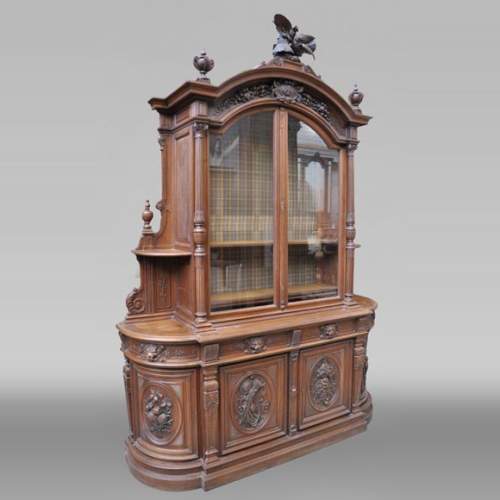
Dimensions:
Width: 220
Height: 302
Depth: 60
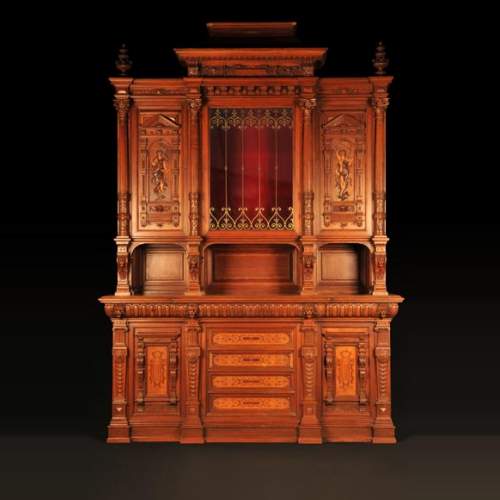
Dimensions:
Width: 209
Height: 294
Depth: 61
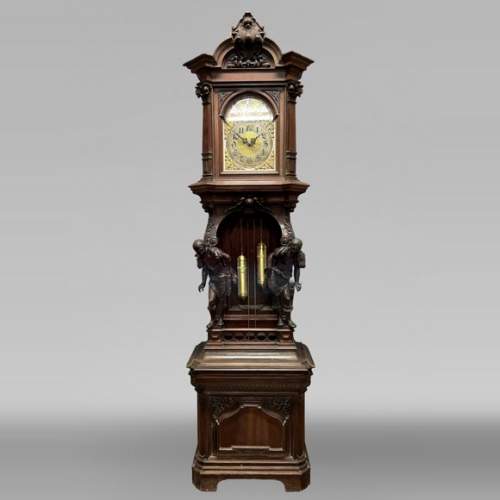
Dimensions:
Width: 72
Height: 255
Depth: 40
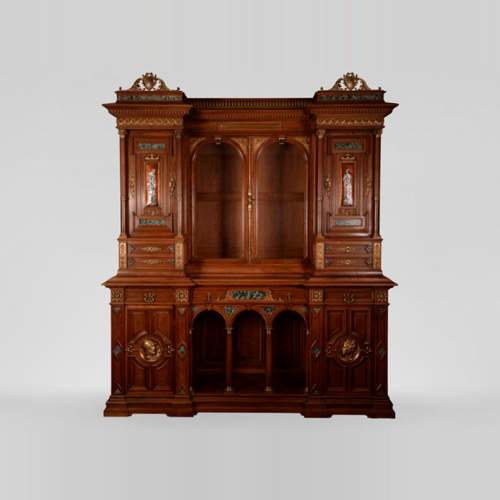
Dimensions:
Width: 230
Height: 262
Depth: 66
Dimensions:
Width: 191
Height: 293
Depth: 56
Dimensions:
Width: 85
Height: 82
Depth: 57