


Style Egyptian / Ref.15570
Giuseppe PARVIS (attributed to), Egyptian Revival Mirror, circa 1900
Dimensions
Width: 20 cm / 7'' ⅞
Height: 44 cm / 17'' ⅜
Depth: 9 cm / 3'' ½
Giuseppe Parvis (1831-1909) studied at the Accademia Albertina in Turin.
Fascinated by Egypt, he moved to Cairo in 1859 to create Egyptian-style furniture.
The cabinetmaker and decorator quickly gained international fame through the Universal Exhibitions in Paris (1867), where he won a gold medal, as well as in Philadelphia (1876), Milan (1881), and Turin (1884).
During the latter, he was awarded a gold medal for his "Egyptian chamber" and "Egyptian-style salon."
Particularly esteemed at the court of the Viceroy of Egypt, he designed the interiors of several palaces before returning to Italy in 1900.
By the early 20th century, Parvis was exporting a significant portion of his production and held considerable market influence.
Upon his death, his son Pompeo took over the business before passing it to his own son, Fernando, who moved away from this historical style in the late 1930s.
The mirror rests on a pink marble base. Its stand is shaped like an inverted, stylized lotus flower corolla, featuring a carved Egyptian face with a postiche beard.
It is surmounted by a motif inspired by an Egyptian deity's headdress, also inverted: two plumes, with their upper tips pointing downward, are crowned by a wave pattern.
This type of headdress can be found on the statues at the sanctuary of Gerf Hussein in Egypt.
The circular, beveled mirror is supported by a cylindrical and then conical neck. The frame is decorated on its lower half with multiple pointed pendants.
On the sides, snakes imitate the uraeus—the sacred attribute of pharaohs—from which hang two blue and white chevron pendants.
The piece is crowned by a scarab with stylized falcon wings, a reference to the god Khepri, the manifestation of the rising sun.
The back of the mirror is equally decorative, covered in embroidered fabric featuring geometric patterns characteristic of ancient Egypt and the uraeus.
Biography of Giuseppe Parvis
Description of the Work
Informations
Price: on request
Recommended for you :
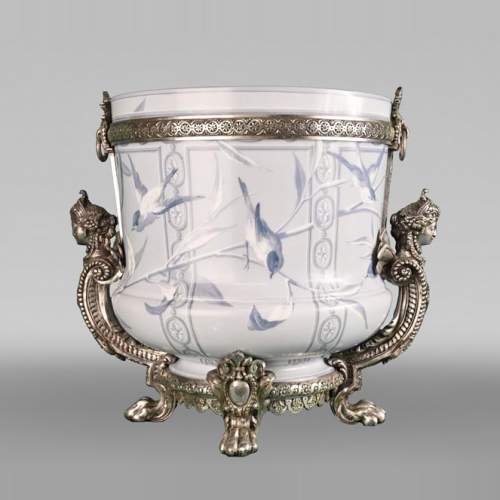
Dimensions:
Height: 35
Diameter: 30
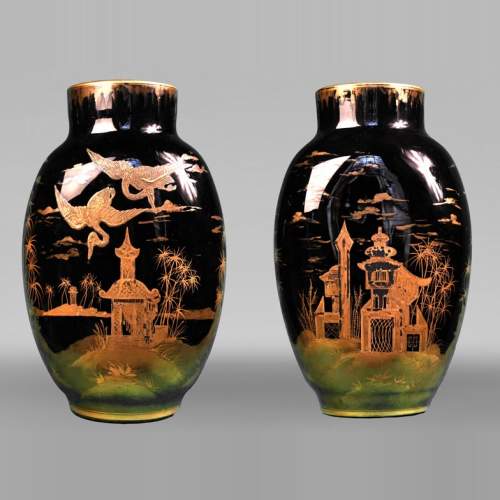
Dimensions:
Width: 20
Height: 34
Depth: 15
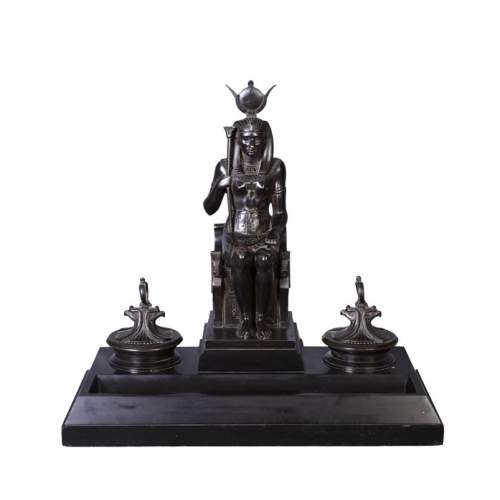
Dimensions:
Width: 42
Height: 39
Depth: 24
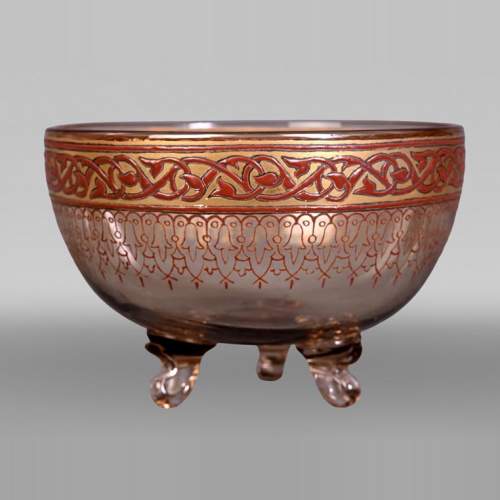
Dimensions:
Height: 8
Diameter: 12
Dimensions:
Height: 38
Diameter: 15
Dimensions:
Height: 7
Diameter: 26
Dimensions:
Width: 122
Height: 76
Depth: 82
Dimensions:
Height: 25
Diameter: 9
Dimensions:
Width: 14
Height: 29
Depth: 9
Dimensions:
Height: 15
Diameter: 12
Dimensions:
Height: 14
Depth: 17
Dimensions:
Height: 26
Depth: 14