menu
Menu
account_box
Categories
Contact
email Send us a message

Contact us

phone By phone

+33 (0)1 42 25 12 79
Tue.-Sat., from 10am to 6pm
+33 (0)6 60 62 61 90
Everyday from 9am to 7pm.

email by Email

Adress: contact@marcmaison.com

share Let's get social

Languages
And also...
My selection
(13 Objects)

My selection (13 Objects)


Monumental Stone Fireplace with Philippe Merlan coat of arms

Ref.4000
Monumental Stone Fireplace with Philippe Merlan coat of arms

Sculpted in 1534 for the Castle of Arnay-Le-Duc, Burgundy MARKS AND INSCRIPTIONS “1534” is engraved in a recessed compartment in the center of the base of the fireplace. The Merlan family coat of arms is located on either side of the frieze outlining the mantel cornice: “A red golden lion, holding on its right a silver cross, surmounted by a silver star, and above are situated three black martlets.” The Merlan family’s motto is engraved on the lintel. Origin The fireplace was created in 1534 on behalf of Philippe Merlan (1503-1546), Baron of Montpont, Lord of Jully-lez-Arnay-le-Duc and general of finances in Burgundy and Bresse under King François the 1st. It was located in his castle of Arnay-le-Duc, in the Côte-d’Or, in the region of Burgundy-Franche-Comté. Upon his death in 1546, ownership was transferred to his son, Gabriel Merlan (1528-1562), Baron of Montpont and Lord of Jully-lez-Arnay-le-Duc. Like his father, he was the Controller-General of finances of Burgundy and Bresse. In 1562, the fireplace was passed to the collection of the family of Chabot-Charny. The castle was sold in 1634 by Françoise Bernarde of Montessus, Countess of Charroux and widow of Charles de Chabot, Nobleman of Mirebeau, to Prince Henri II of Bourbon-Condé (1588-1646), King of France for a short time. It stayed in the collection of his son, Louis II de Bourbon-Condé (1621-1686), known as the Great Condé, famous conqueror of Rocroi (1643) until 1675. That year it was given back to the family of Chabot until 1778. During this period, the lands of Arnay passed from the Chabots to the Rohans, then to the Brions through marriages. The piece was sold in 1778 by Marie-Louise-Julie-Constance of Rohan, Countess of Brionne, to the royal house of the Ladies of Saint-Cyr who inhabited the castle until the Revolution. It was used as the town hall until 1792, when it was sold as National property. It passed from hand to hand until eventually it was bought in the mid 1860s by Jean-François-Henri Bouruet (1801-1870), one of the rich owners of the famous “Au Gagne-Petit’’ stores in Paris, who stripped much of the woodwork, sculptures and its eight fireplaces, including our mantel. The fireplace was moved to one of the rooms of the neo-Renaissance castle of Villemenon in Servon, Seine-et-Marne, which Jean-François-Henir Bouruet had recently built. The mantel remained there even after the death of Mr. Bouruet in 1870 and the castle was sold by his heirs. Over the next 150 years, the castle of Villemenon became the property of Mr. Jeanson (from 1870 to 1875), Mr. Boutet (from 1875 to 1911), Mr. Droui de M.Méhu, banker in Paris, and finally Hélène Martini (1924-2017), famous director of theaters, cabarets and theaters, often referred to as the “Queen of the Parisian night.”

Dimensions:
Width: 350 cm
Height: 428 cm
Depth: 92 cm
Inner width: 235 cm
Inner height: 190 cm

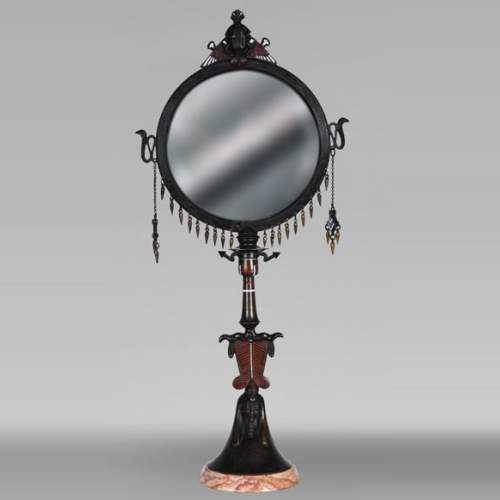
Giuseppe PARVIS (attributed to), Egyptian Revival Mirror, circa 1900

Ref.15570
Giuseppe PARVIS (attributed to), Egyptian Revival Mirror, circa 1900

Biography of Giuseppe Parvis Giuseppe Parvis (1831-1909) studied at the Accademia Albertina in Turin. Fascinated by Egypt, he moved to Cairo in 1859 to create Egyptian-style furniture. The cabinetmaker and decorator quickly gained international fame through the Universal Exhibitions in Paris (1867), where he won a gold medal, as well as in Philadelphia (1876), Milan (1881), and Turin (1884). During the latter, he was awarded a gold medal for his "Egyptian chamber" and "Egyptian-style salon." Particularly esteemed at the court of the Viceroy of Egypt, he designed the interiors of several palaces before returning to Italy in 1900. By the early 20th century, Parvis was exporting a significant portion of his production and held considerable market influence. Upon his death, his son Pompeo took over the business before passing it to his own son, Fernando, who moved away from this historical style in the late 1930s. Description of the Work The mirror rests on a pink marble base. Its stand is shaped like an inverted, stylized lotus flower corolla, featuring a carved Egyptian face with a postiche beard. It is surmounted by a motif inspired by an Egyptian deity's headdress, also inverted: two plumes, with their upper tips pointing downward, are crowned by a wave pattern. This type of headdress can be found on the statues at the sanctuary of Gerf Hussein in Egypt. The circular, beveled mirror is supported by a cylindrical and then conical neck. The frame is decorated on its lower half with multiple pointed pendants. On the sides, snakes imitate the uraeus—the sacred attribute of pharaohs—from which hang two blue and white chevron pendants. The piece is crowned by a scarab with stylized falcon wings, a reference to the god Khepri, the manifestation of the rising sun. The back of the mirror is equally decorative, covered in embroidered fabric featuring geometric patterns characteristic of ancient Egypt and the uraeus.

Dimensions:
Width: 20 cm
Height: 44 cm
Depth: 9 cm

POINT Armand, Ring holder

Dimensions:
Width: 16 cm
Height: 7 cm
Depth: 6 cm