menu
Menu
account_box
Categories
Contact
email Send us a message

Contact

phone By phone

+33 (0)1 42 25 12 79
Tue.-Sat., from 10am to 6pm
+33 (0)6 60 62 61 90
Everyday from 9am to 7pm.

email by Email

Adress: contact@marcmaison.com

share Let's get social

Languages
And also...
My selection
(11 Objects)

My selection (11 Objects)


Jean-François GECHTER (Att. to) - "Bonaparte crossing the Great Saint Bernard", important patinated bronze sculpture

Ref.10841
Jean-François GECHTER (Att. to) - "Bonaparte crossing the Great Saint Bernard", important patinated bronze sculpture

This important patinated bronze sculpture, representing General Bonaparte crossing the Great-Saint-Bernard, is attributed to the romantic sculptor Théodore Gechter (1796-1844). The general is represented according to tradition, « calme on a fiery horse », although he had crossed the pass on a mule. The prancing animal confers a dynamism to the composition, which is reinforced by the grandiloquent gesture of Bonaparte draped in a loose cloak. The victorious general, with an idealized face, looks at the spectator and shows him the direction to follow, this third political way which he sought to impose between the royalists and the republicans . This beautiful sculpture was executed after the famous painting by Jacques-Louis David (1748-1825). This representation commemorates the victorious passage, in May 1800, of the Great-Saint-Bernard pass by the reserve army under the direction of the First Consul, the first stage of his triumphal reconquest of Italy. With great audacity, Bonaparte played the surprise by crossing a pass, deemed impratical in the spring. He returned to the feat of great captains of the past : Hannibal, passing through the Alps with his elephants in 218 during the Second Punic War, and Charlemagne, in 773, in his fight against Lomabards. Even before the Napoleonic victories, Austerlitz, Jena, Friedland, Wagram, the painting inscribed the name of Bonaparte among those of the greatest conquerors of History. The composition of David, taken up by Théodore Gechter, is an absolute icon, archetype of the representation of the hero of the Revolution, probably the most famous portrait of Napoleon around the world. There are several bronzes edition of this model. The representation of Gechter differs in several points from that of the painter J. L. David. General Bonaparte, realized by Gechter does not look at the spectator but at the ground. This rocky and eventful base underscores the obstacles that General Bonaparte has had to face and thus reinforces his heroic action. It should also be noted that Gechter did not go so far as to inscribe the names of victorious conquerors on the rock, as in the case of David’s painting. We find the fiery movement of the characters in Charles Martel and Abdérame, King of the Saracens, plaster group presented by Gechter at the Salon of 1833. A bronze model, commissionned by the Ministry of Commerce and Industry, melted by Gonon is now preserved in the Louvre. The sculptor represents Charles Martel in armor slaying his enemy. The representation of the rider is a pretext for the study of the movement and contortions of the horse. The expression of the warriors pride and this victorious feeling is the sign of a romanticism peculiar of Gechter. The artist has taken great care with the modeling of theses faces, perfectly catching the light. The precision in rendering the details is obvious (the helmet, the crafted brigantine, the chainmails). In addition, Gechter alternates in his compositions rough surfaces, smooth or chiseled throughout the sculpture, precisely as in the Bonaparte crossing the Great-Saint-Bernard. The extraordinary quality of our sculpture, the composition in movement, the precision in the rendering of the details suggest that it is indeed a model of Gechter, executed around 1840. This bronze sculpture is of high quality, by the delicacy of carving, the quality of the details and ornaments, the fiery movement, which are characteristic of Théodore Gechter, a romantic sculptor who particularly liked the modeling of horses.

Dimensions:
Width: 53 cm
Height: 63 cm
Depth: 25 cm

Joseph Chéret (1838 - 1894) for the Manufactory of Sèvres "Putto with greek masks" Coin tray made in faience with a blue glaze

Ref.15462
Joseph Chéret (1838 - 1894) for the Manufactory of Sèvres "Putto with greek masks" Coin tray made in faience with a blue glaze

This coin tray was made in blue glazed faience in the 19th century by the manufacture of Sèvres, after an artwork of Joseph Gustave Cheret (1838-1894). This sculpture represents a putto with two Greek comedy masks. The first one, sitting at its foot, is a woman's mask of a courtesan called 'pseudokoré'. The putto is holding the other one in his arms, it is the mask of a bearded man called 'pornoboskos'. The putto is partially covered with a drape. At his feet are severals musical instruments : a flute, some bells and a tambourine, with the signature 'Joseph Cheret Saw'. Another mark 'CH FICQUENET. - Sevres' is on the side. Cheret is an important sculptor of the 19th century. He was trained by the famous Carrier-Belleuse. This very gifted student eventually married one of the daughters of his mentor in 1868. From 1863 he regularly presented works in different Fairs and Exhibitions. We owe him the first salamander design, which he realized in collaboration with the Chaboche Company. This object is inspired by sculptures depicting putti or young satyrs having fun with Greek comedy masks. Very popular in the imperial Rome period, these images are experiencing a revival during the Renaissance and then in the 19th century during eclecticism. It is particularly representative of the 19th century taste, especially by its material: a blue glazed faience. At that time, ceramic techniques were very popular. This blue can be compared to 'Deck blue', used by Théodore Deck at the same time.

Dimensions:
Width: 25 cm
Height: 63 cm
Depth: 27 cm

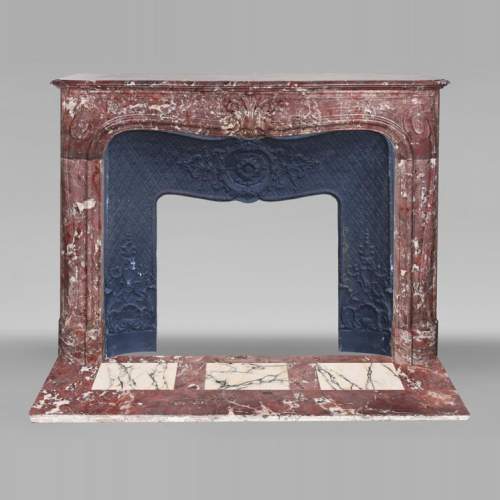
Napoleon III style mantel with modillions carved in Enjugerais marble

Dimensions:
Width: 119 cm
Height: 100 cm
Depth: 35 cm
Inner width: 83 cm
Inner height: 78 cm

Gabriel VIARDOT (1830-1909), Japanese-style bedroom furniture set

Ref.13909
Gabriel VIARDOT (1830-1909), Japanese-style bedroom furniture set

A talented wood sculptor, Gabriel Viardot opened a furniture factory and shop in Paris in 1853. In the 1870s, he decided to dedicate himself to Japonisme furniture. Participating in the numerous exhibitions that marked the art scene of the second half of the 19th century, his contributions were met with great success. He won a silver medal at the Universal Exhibitions of 1878, 1885, and 1889, and then a gold medal at the Universal Exhibition of 1900. This furniture is very similar to a set dated 1887 by Céline Béral (see archive photographs (1)). If it is indeed the same set, this would prove that it has been kept together since its creation nearly 150 years ago. This would be highly unusual. This furniture shows characteristics typical of Viardot's work: asymmetrical shelf design, pagoda profiles, tabletops with inverted curves at the ends, and so on. The wardrobe and bed are exceptional for their imposing dimensions. Standing 2.18 meters tall, the sycamore wardrobe features a pagoda profile and remarkable mother-of-pearl and ivory decoration depicting genre scenes within a sculpted background that blends cherry blossom branches, maple leaves, and engraved butterflies. The footboard is decorated with exceptional flowers carved in a particularly fluid and naturalistic style. At the center of a meandering "T" motif, a menacing dragon's head emerges. An openwork pagoda profile surmounts a floral garland on the headboard, while the corners take on the appearance of Japanese-style bollards adorned with scrolling foliage. The dressing table's cabriole legs feature gilt-bronze decorations, and it retains its mirror, adorned at the top with a flowering cherry branch. In 1887, the year our set was made, the Revue des Arts Décoratifs reported on the pieces presented by Gabriel Viardot at the Exhibition of the Union Central des Arts Décoratifs, among which were mentioned "a very picturesque sideboard, a fantastic bed whose form and details seem to have been designed by an artist from the Middle Kingdom [...]". Given the lack of certainty regarding the pieces exhibited, it is reasonable to wonder why our pieces, signed and dated 1887, were photographed and whether they held particular value. Are these, at least in part, the items exhibited in 1887?

Dimensions:
Width: 218 cm
Height: 247 cm
Depth: 210 cm

F. GERDERÈS – Japanese-style billiard table in gilded and carved wood

Ref.15738
F. GERDERÈS – Japanese-style billiard table in gilded and carved wood

This rare Japanese-style billiard table in gilt and carved wood bears the plaque of the Parisian manufacturer F. Gerderès. Famous for the quality and inventiveness of its billiard tables, the Gerderès company participated in the 1867 Universal Exhibition. This model is undoubtedly among the most original designs of its time, capitalizing on the vogue for Japonisme in the last third of the 19th century. Our billiard table rests on four imposing gilt bronze legs in the form of vases. These feature motifs inspired by Japanese script, Greek key patterns, and handles with rings. The tall, flared neck supports a playing surface composed of three slates, a material of choice for ensuring a perfectly level billiard table. The frieze features superb marquetry lacquer panels, set within molded frames. The marquetry decoration is characteristic of the Japonisme style: it depicts cherry blossom branches and birds. Gilded wood ornaments stand out sharply against the lacquered border: across the width, three cornflowers unfurl on an acanthus leaf base in a striking Rococo style. Along the length, the border features a menacing gilded Japanese-style dragon resting on an acanthus leaf. Openwork Japanese-style friezes accentuate the profile of the billiard table, further emphasizing the Asian architectural reference. The billiard table has a score counter stamped by the manufacturer, indicating its address and the inscription "Precision Billiards." This high-quality Japanese-style billiard table is one of the few known examples.

Dimensions:
Width: 279 cm
Height: 86 cm
Depth: 155 cm