menu
Menu
account_box
Categories
Contact
email Send us a message

Contact

phone By phone

+33 (0)1 42 25 12 79
Tue.-Sat., from 10am to 6pm
+33 (0)6 60 62 61 90
Everyday from 9am to 7pm.

email by Email

Adress: contact@marcmaison.com

share Let's get social

Languages
And also...
My selection
(4 Objects)

My selection (4 Objects)


Eugène-Frédéric PIAT (1827-1903) - Pair of Japanese wall brackets, a similar model of which belonged to Sarah Bernhardt

Ref.10521
Eugène-Frédéric PIAT (1827-1903) - Pair of Japanese wall brackets, a similar model of which belonged to Sarah Bernhardt

Bronze with brown patina, glazed stoneware phoenixes (China, 19th century) H. 83 cm / 32’’ 11/16 ; W. 25cm / 9’’ 13/16 ; D. 25cm. / 9’’ 13/16 This model of wall brackets was created by Frédéric Eugène Piat for the Maison Gagneau in Paris. According to the description proposed by the Museum of Troyes in its "Catalog of Decorative Arts" of 1897, there are arms of light composed of a "Chinese modillon with two brackets, an entablature and a gallery with openwork". Inspired by Chinese art, this pair of wall brackets combines the Far Eastern motifs with French ornamental elements: rinceau scrolls and interlaces characteristic of the Louis XV style, illustrating the vogue for eclecticism that marks the artistic production in the 19th century. The motif of the Asian monster recalls the lions mufles made by the artist in its works of Renaissance inspiration while evoking the imaginary bestiary of Japonism; the monster holds in its jaws a ring that recalls a knocker but devoid of its primary purpose as it is indeed a purely decorative element. The same model belonged to the actress Sarah Bernhardt and is visible on old photographs of her Parisian house. The same pair of wall brackets adorned her studio. Frédéric-Eugène Piat (1827-1903) was one of the leading French sculptors and ornamentalists of the 19th century at the beginning of, with Louis-Constant Sévin in particular, the renewal and development of the French bronze industry. An active member of the Bronzes Manufacturers' Association, he is one of those who have merged art and industry. He later became one of the founders of the Central Union of Fine Arts Applied to Industry in 1864. After training with sculptors and ornamentalists, he started his own business in 1845 and enjoyed a good reputation in the 1850s. During the next decade, he began a collaboration with the founder Louis Léon Marchand (1831-1899). In the 1870s, he collaborated with eminent manufacturers: Georges Édouard Gagneau, Charles de Marnyhac, Emile Colin and the Val d'Osne Foundry. His artistic consecration takes place from the year 1873: while he designs models to be exhibited at the World’s Fair of 1873 in Vienna, he receives the visit of the President of the Republic Adolphe Thiers who makes him knight of the Legion of Honor for his fruitful contribution in the field of the bronze industry in French art. He participated at the Parisian Salons and at nine World’s Fairs in the second half of the century. He is particularly noticed during the World’s Fair of 1878 held in Paris where he exhibited a vast collection of works of art thanks to which he received a gold medal, but especially during the World’s Fair of 1889 when he was decorated with the Grand Prix, higher reward ever given to an industrial artist. Thanks to the quality and style of his productions, which are typical of the taste of the time for historicism and eclecticism, and as shown by this pair of Japanese-style consoles, Piat enjoyed not only a nation-wide reputation but also international.

Dimensions:
Width: 25 cm
Height: 83 cm
Depth: 25 cm

Victor GEOFFROY-DECHAUME, Pair of incense burners made out of silvered bronze, adorned with dogs, circa 1840

Ref.12389
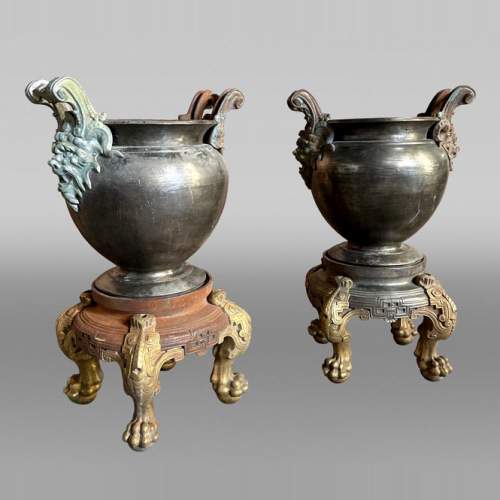
Victor GEOFFROY-DECHAUME, Pair of incense burners made out of silvered bronze, adorned with dogs, circa 1840

This pair of incense burners made out of silvered bronze and adorned with dogs is a work by the goldsmith and sculptor Victor Geoffroy-Dechaume (1816-1892), as indicated by the chiselled signature on the covert’s backs. This pair of incense burners is a testimony of the taste, combining references to the arabic and medieval arts, that develops itself during the 1840 decade, in every field of the decorative arts and in particular in the work of Victor Geoffroy-Dechaume, a prolific designer for civil and religious goldsmithing models. He entered the Beaux-Arts school of Paris in 1831, where he was the student of David d’Agners and James Pradier. His taste pushed him into dedicating himself to decorative arts, and in particular to model designs for goldsmithing, until 1848, when he discovered the medieval sculpture. He gave numerous designs for other artists to use as models, for example the bronzemaker Auguste-Maximilien Delafontaine (1813-1892) or the goldsmith François-Désiré Froment-Meurice (1801-1855). Then, circa 1850, he went for the study of monumental statuary and more accurately of medieval statuary. He became one of Viollet-le-Duc’s principal collaborators and participated thus at some of the biggest restoration sites, like the Chartres cathedral, Notre-Dame of Paris or the Sainte-Chapelle. A multiple and fecund artist, he was at the same time a restorator of religious buildings, a sculptor of monumental pieces, commemorative statues, a goldsmith for the princes and a prolific moulder. In 1855, Geoffroy-Dechaume is appointed director at the Museum for Comparative sculpture (actual Cité de l’Architecture et du Patrimoine). Our pair of incense burners is thus realised according to the main works of the first part of Geoffroy-Dechaume’s career. At this time he dedicated himself to decorative arts and to goldsmithing by producing models and works which ornamental references find their sources into arabic and medieval arts. We recognize these inspirations thanks to the polylobed and animated shapes of our incense burners. Made out of silvered bronze, they present on the top two small sculptures depicting dogs. Their bodies have been pounded with small, abstract patterns bringing them some texture and reminding of the oriental inspiration. The two scenes are different, since on the first one, we can see the dogs fighting, sitted, one biting the other’s neck, while on the other burner, a sitting female is nourishing her babies. These canine figures are set on a ring adorned with oriental patterns and pierced with holes in order for the incense to spread. On the four-feeted base, the sinuous lines and the decoration does form an hybridisation between oriental art and grotesque or even monstruous forms from gothic art, for example with the stylished paw-feet or the scale motif. Bibliography : Catalogue of the exhibition « De plâtre et d’or. Geoffroy-Dechaume sculpteur romantique de Viollet-le-Duc. » Musée d’art et d’Histoire Louis Senlecq, L’Isle-Adam, 1998.

Dimensions:
Width: 24 cm
Height: 37 cm
Depth: 24 cm