Ref.15441
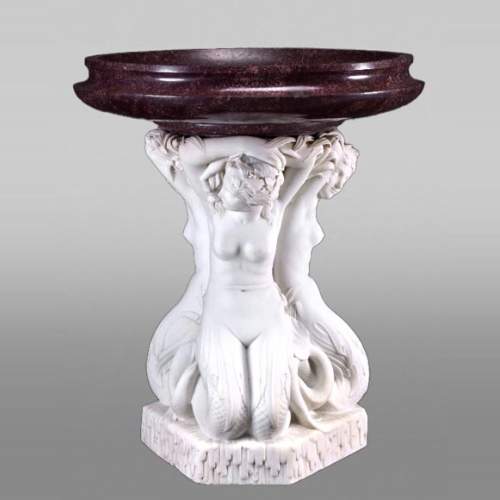
Jean-Jacques FEUCHÈRE (attributed to), Jardiniere with Three Tritonesses in Porphyry and Marble, first half of the 19th century
This jardiniere with three tritonesses was created in the first half of the 19th century, with the sculpture attributed to Jean-Jacques Feuchère, and the basin (or labrum) in porphyry dating back to the 17th century.
Porphyry is “a purple rock speckled with white, extracted from the Eastern Egyptian desert”. Due to its color, it was associated with imperial prestige in antiquity. Its extreme hardness, requiring expert craftsmanship, further enhances the symbolic prestige of this material. The quarries where porphyry was mined were located in the Egyptian desert and were abandoned in the 5th century. As a result, all objects made between that time and the 18th century were created by reusing ancient pieces. Here, the porphyry is paired with white marble, creating a harmonious contrast between the two parts of the work.
The porphyry basin is inspired by models of ancient labra as found in the most prestigious Roman baths. However, it was likely made in the 17th century, a time when the cutting of porphyry resumed. Its perfectly circular form, carved from a single block, is emphasized by alternating convex and concave curves, with the upper section flaring outwards. A discreet circular opening allows water to drain.
The sculpture serving as the support for the basin is attributed to Jean-Jacques Feuchère (Paris, 1807-1852). The son of a chiseler, Feuchère initially worked for goldsmiths and bronze manufacturers before transitioning to more monumental work. He exhibited at nearly every Parisian Salon from 1831 until his death in 1852.
The sculptural ornamentation is intricately detailed. On a hexagonal base covered in moss from moisture, three kneeling tritonesses rest on their split fish tails, which intertwine with those of their neighbors. Algae transition between their fish-like lower bodies and their feminine upper bodies. The three tritonesses, their heads tilted to the side and crowned with leaves and fruits, act as caryatids, supporting the basin with their folded arms, which are joined behind their heads. Reeds emerge between each of them.
The motif of the tritonesses is inspired by numerous 18th-century works featuring hybrid aquatic creatures, especially in Rococo and Baroque art. However, their style belongs to the 19th century, a time when similar motifs were revived.
The tritoness motif also appears in the design of the central piece of a surtout created by François-Désiré Froment-Meurice (1801-1855) for the Duke of Luynes between 1846 and 1851 (now in the Louvre Museum), based on a drawing by Jean-Jacques Feuchère. A photograph in the collections of the Orsay Museum, taken around 1858, provides a clear view of these figures, particularly one whose posture closely resembles that of our tritonesses. Our jardinière follows in the tradition of this iconic work.
The fountain formerly located on Rue du Faubourg Saint-Martin in the 10th arrondissement of Paris, erected in 1843, features the same motif: on either side of the fountain’s base, a triton and a tritoness with intertwined tails support a basin in their folded arms, which in turn holds a putto and a swan. As with our jardiniere, the tritoness has a double fish tail, a subtle transition between human and animal forms, and the posture of a caryatid with her arm raised over her head.
Nearly identical tritoness-caryatids to those on the Parisian fountain were still offered for casting by the Ducel Foundry, later acquired by the Val d’Osne foundry, among their fountain and basin ornaments (Ducel-Val d’Osne catalog, circa 1880, plate 212).
The tritoness motif characterizing our jardinière, a popular theme in the 19th century, was already in use in the first half of the century by Jean-Jacques Feuchère or foundries, among others. It continued to be significant in the second half of the century, though the motif became more standardized, unlike the uniqueness and originality of the sculpted base of our work.