menu
Menu
account_box
Categories
Contact
email Send us a message

Contact

phone By phone

+33 (0)1 42 25 12 79
Tue.-Sat., from 10am to 6pm
+33 (0)6 60 62 61 90
Everyday from 9am to 7pm.

email by Email

Adress: contact@marcmaison.com

share Let's get social

Languages
And also...
My selection
(6 Objects)

My selection (6 Objects)


TIFFANY Studios, Mosque Lamp in "favrile" glass, early 20th century

Ref.15380
TIFFANY Studios, Mosque Lamp in "favrile" glass, early 20th century

This mosque lamp was created by the Tiffany Studios at the beginning of the 20th century. Its design was conceived by Louis Comfort Tiffany in 1905. Louis Comfort Tiffany was the son of Charles Tiffany, the founder of Tiffany and Co., a renowned New York jewelry and silverware company. Initially a painter and interior decorator, he later became interested in the art of glass. In 1893, he founded his first glass factory under his name. He notably invented “favrile glass”, a term derived from the English “fabrile” (“belonging to an artist or their art”) to mimic the iridescent effect of antique glass, achieving a lustrous and shimmering appearance by adding metallic salts to the molten glass. The base, body, and cover of the lamp are three distinct, separable parts of the piece. The octagonal ebony base holds the lamp's foot of the same shape, topped by a spherical cap, with a matching cover above it. While the base glass is matte, the upper part is decorated with lustrous green and mauve petal-shaped motifs. When lit, the lamp emits a warm glow. This creation falls within the Art Nouveau movement, in which Tiffany excelled, particularly at the end of the 19th and beginning of the 20th centuries. Its shape resembles a mushroom, and the plant motifs in its decoration reflect the object’s natural inspiration. It also reveals Tiffany’s fascination with all kinds of lighting, from the antique oil lamps of Pompeii to the Near Eastern inspiration of this mosque lamp from the artist’s travels. Several other lamps were made following this model. One of them, similar to ours, is listed in the book Louis C. Tiffany. The Garden Museum Collection by Alastair Duncan (p. 317), as being present in this museum’s collection.

Dimensions:
Height: 22 cm

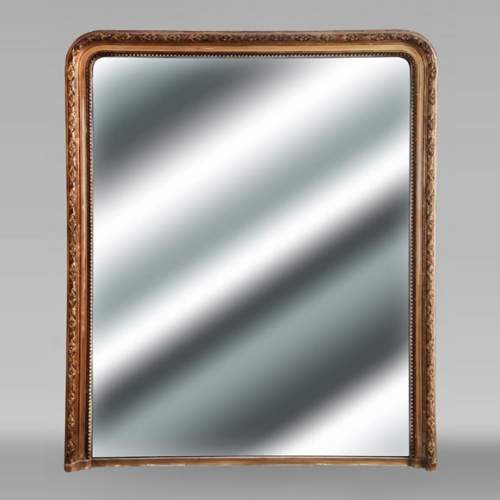
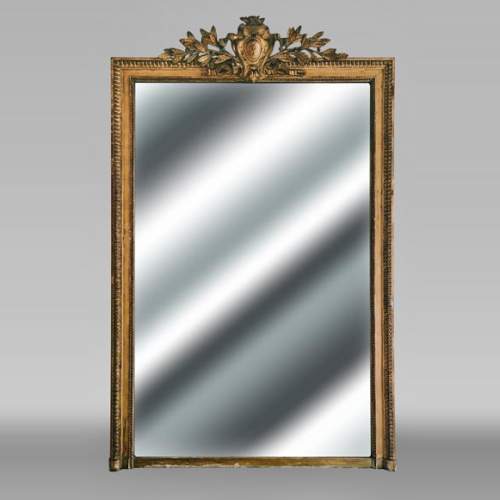
Napoleon III style gilded trumeau decorated with a frieze of oak leaves

Dimensions:
Width: 138 cm
Height: 250 cm
Depth: 17 cm
Inner height: 236 cm

Polylobed work table with insects and butterflies

Ref.16138
Polylobed work table with insects and butterflies

Set upon a triangular base in floral marquetry, three curved service-tree wood legs—whose form was only made possible after the adoption of the wood-bending techniques developed by the Viennese firm Thonet—cross elegantly to support a gracefully designed polylobed basket-shaped body. The curving sides of this basket are decorated with marquetry panels composed of various woods—amaranth, birch, East Indian ebony, maple, holly, and stained holly—where a dragonfly and a butterfly flutter among leafy branches. The polylobed lid, fitted with a mirror framed by a twisted moulding, opens to reveal an interior upholstered in raspberry-colored silk. The fully marqueted blooming flower on the top continues the same naturalistic and vegetal theme. At the three corners of the basket and running along the legs, patinated and painted bronze ornaments constitute one of the most distinctive aspects of the piece: hanging flowers, foliage, and a large grasshopper whose remarkable realism is heightened by the coloration of the bronzes, producing striking trompe-l’œil effects. This animal presence evokes the imagery of Japanese prints, then highly fashionable in Paris. The table thus brings together ideas from diverse sources: marquetry inherited from the 18th century, animal ornamentation close to the naturalistic sculpture of the second half of the 19th century, and a structural design derived from Viennese cabinetmaking. The composition anticipates certain developments of Art Nouveau. Several versions of this model are known, including one preserved at the Musée de l’École de Nancy and another at the Musée d’Orsay. The first version was presented hors concours at the Exposition Universelle of 1878. Service-tree wood legs; marquetry of various woods; patinated and painted bronzes; fabric and upholstery; mirror.

Dimensions:
Height: 73 cm