menu
Menu
account_box
Categories
Contact
email Send us a message

Contact us

phone By phone

+33 (0)1 42 25 12 79
Tue.-Sat., from 10am to 6pm
+33 (0)6 60 62 61 90
Everyday from 9am to 7pm.

email by Email

Adress: contact@marcmaison.com

share Let's get social

Languages
And also...
My selection
(11 Objects)

My selection (11 Objects)


Mantle garniture in the orientalist taste  in gilt-bronze with  polychrome porcelain decoration

Ref.17390
Mantle garniture in the orientalist taste in gilt-bronze with polychrome porcelain decoration

Polished and varnished bronze, polychrome porcelainThis exquisite orientalist mantle garniture was inspired by an eclectic range of decorative source materials and is characteristic of French works of art produced in the 1880s. Fashioned in gilt-bronze and ornamented with porcelain polychrome plaques decorated with vegetal scrolls and cartouches inspired by Iznik enamels, the clock takes the form of a piece of miniature architecture. The clock face is framed by two columns whose capitals support an open foliated pediment directly inspired by Islamic monuments. The clock is accompanied by a pair of vases of Byzantine form, the sides of which are encircled with a porcelain band that echoes the clock’s decoration. The body of the vases is also ornamented with chased bronze of the highest quality. This beautifully chased bronze work comprises palmettos of stylized organic shapes and delicate scrollwork. Certain of the bronze elements are executed in openwork, such as the handles of the vases.    Although not signed, this garniture is inscribed “Paris” under the face of the clock, indicating that this exceptional piece was the work of a French manufacturer. Created around 1880, this set is characteristic of the taste for eclecticism, the divergent sources used and the wide ornamental vocabulary taken from many different periods and continents that created this arresting and original work of art. 

Dimensions:
Width: 22 cm
Height: 43 cm
Depth: 13 cm

Louis - Constant SEVIN & Ferdinand BARBEDIENNE - Beautiful pair of ornament vases in bronze and  cloisonne enamel, circa 1862

Ref.13458
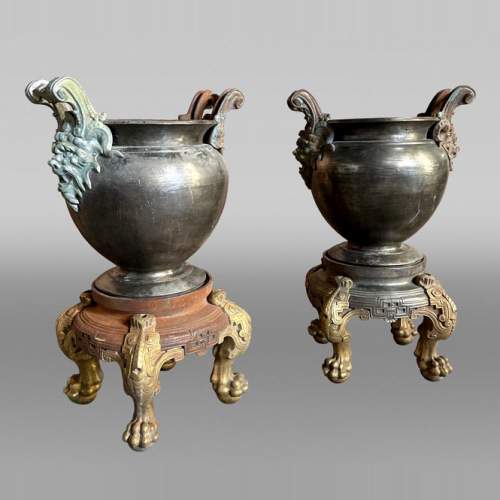
Louis - Constant SEVIN & Ferdinand BARBEDIENNE - Beautiful pair of ornament vases in bronze and cloisonne enamel, circa 1862

This beautiful pair of vases is the result of the collaboration between Louis Constant Sevin (1821 – 1888), drawer and designer, and Ferdinand Barbedienne (1810 – 1892), bronze maker and founder of the famous 19th century foundry of the same name. Indeed, even though they are only bearing the signature of the last one, we can compare our vases to another pair presented on the Barbedienne's stand during the International Exhibition of London in 1862 depicting the same decor. We owe to the associations of the two men – which has lasted for more than thirty years, between 1855 and 1888 – an important collection of works of art and especially vases, showing the same colors and technical. Our ornamental vases were made in bronze and show an outstanding and abundant decoration of enamel cloisonne. The gilt bronze on the blue background and the polychromatic richness of the motif reminds of an imaginary and an inspiration coming from the East. They rest on three gilt bronze feet with cat's heads, finished with claws. We notice in the shape and the decoration an eastern inspiration but above all an eclectic one, characteristic of the artistic tendency in France under the Second Empire. Indeed, Constant Sevin was inspired by patterns belonging to the Arabic, or Persian decorative repertoires for the decoration. While the handles with cat's heads tend toward reminding Egypt, the technic of divided enamel dates back to Middle Ages. With the creation of this pair of vases Ferdinand Barbedienne and Constant Sevin participate to the reborn of champleve enamel in the middle of the 19th century. Indeed, the polychromatic decoration, omnipresent in the industrial arts during the Second Empire, finds in this technic a perfect expression. Inspired by examples of champleve enamels made during the Middle-Ages, this technic was innovated by obtaining directly during the melt the network of partitions to produce a draw of a irreproachable clarity and regularity. The first technical tries of Barbedienne were made near 1858 and four years after he presents in the Great Exhibition of London a stand mainly composed of works of art inlaid of enamels – very likely the model of our vase – which does not leave the critic indifferent. Alfred Darcel (1818 – 1893), art critic, said in his report on the Great Exhibition of 1862, published in the Gazette des Beaux-Arts : "Among the numerous works of art exhibited by Mr Barbedienne, we did not see anything more gripping than the objects decorated with enamels, kind of decoration he knew how to apply with success. […] With enamels painted that have conceded nothing to the most beautiful works of art of the 16th century first masters.[…] "

Dimensions:
Width: 30 cm
Height: 33 cm
Depth: 29 cm

Jean-Jacques FEUCHÈRE (attributed to), Jardiniere with Three Tritonesses in Porphyry and Marble, first half of the 19th century

Ref.15441
Jean-Jacques FEUCHÈRE (attributed to), Jardiniere with Three Tritonesses in Porphyry and Marble, first half of the 19th century

This jardiniere with three tritonesses was created in the first half of the 19th century, with the sculpture attributed to Jean-Jacques Feuchère, and the basin (or labrum) in porphyry dating back to the 17th century. Porphyry is “a purple rock speckled with white, extracted from the Eastern Egyptian desert”. Due to its color, it was associated with imperial prestige in antiquity. Its extreme hardness, requiring expert craftsmanship, further enhances the symbolic prestige of this material. The quarries where porphyry was mined were located in the Egyptian desert and were abandoned in the 5th century. As a result, all objects made between that time and the 18th century were created by reusing ancient pieces. Here, the porphyry is paired with white marble, creating a harmonious contrast between the two parts of the work. The porphyry basin is inspired by models of ancient labra as found in the most prestigious Roman baths. However, it was likely made in the 17th century, a time when the cutting of porphyry resumed. Its perfectly circular form, carved from a single block, is emphasized by alternating convex and concave curves, with the upper section flaring outwards. A discreet circular opening allows water to drain. The sculpture serving as the support for the basin is attributed to Jean-Jacques Feuchère (Paris, 1807-1852). The son of a chiseler, Feuchère initially worked for goldsmiths and bronze manufacturers before transitioning to more monumental work. He exhibited at nearly every Parisian Salon from 1831 until his death in 1852. The sculptural ornamentation is intricately detailed. On a hexagonal base covered in moss from moisture, three kneeling tritonesses rest on their split fish tails, which intertwine with those of their neighbors. Algae transition between their fish-like lower bodies and their feminine upper bodies. The three tritonesses, their heads tilted to the side and crowned with leaves and fruits, act as caryatids, supporting the basin with their folded arms, which are joined behind their heads. Reeds emerge between each of them. The motif of the tritonesses is inspired by numerous 18th-century works featuring hybrid aquatic creatures, especially in Rococo and Baroque art. However, their style belongs to the 19th century, a time when similar motifs were revived. The tritoness motif also appears in the design of the central piece of a surtout created by François-Désiré Froment-Meurice (1801-1855) for the Duke of Luynes between 1846 and 1851 (now in the Louvre Museum), based on a drawing by Jean-Jacques Feuchère. A photograph in the collections of the Orsay Museum, taken around 1858, provides a clear view of these figures, particularly one whose posture closely resembles that of our tritonesses. Our jardinière follows in the tradition of this iconic work. The fountain formerly located on Rue du Faubourg Saint-Martin in the 10th arrondissement of Paris, erected in 1843, features the same motif: on either side of the fountain’s base, a triton and a tritoness with intertwined tails support a basin in their folded arms, which in turn holds a putto and a swan. As with our jardiniere, the tritoness has a double fish tail, a subtle transition between human and animal forms, and the posture of a caryatid with her arm raised over her head. Nearly identical tritoness-caryatids to those on the Parisian fountain were still offered for casting by the Ducel Foundry, later acquired by the Val d’Osne foundry, among their fountain and basin ornaments (Ducel-Val d’Osne catalog, circa 1880, plate 212). The tritoness motif characterizing our jardinière, a popular theme in the 19th century, was already in use in the first half of the century by Jean-Jacques Feuchère or foundries, among others. It continued to be significant in the second half of the century, though the motif became more standardized, unlike the uniqueness and originality of the sculpted base of our work.

Dimensions:
Height: 78 cm

Napoleon III style gilded trumeau decorated with a frieze of oak leaves

Dimensions:
Width: 138 cm
Height: 250 cm
Depth: 17 cm
Inner height: 236 cm