


Style Egyptian / Ref.14204
Albert ANKER (painter), Théodore DECK (ceramist), Ornamental Dish “Cleopatra”, 1869
Dimensions
Width: 33 cm / 13''
Height: 5 cm / 2''
Depth: 33 cm / 13''
diameter: 33 cm / 13''
Origin:
19th century
Status:
Good condition
The Swiss painter Albert Anker (1831-1910) joined the École des Beaux-Arts in Paris in 1855. Alongside his close collaboration with Théodore Deck, Anker distinguished himself in the genre of historical portraiture. Between 1866 and 1892, the two artists produced over 450 faience pieces together, combining their talents to create exceptional works.
Théodore Deck (1823-1891) established himself in Paris in 1858. After manufacturing linings for heating systems, he turned to ceramics, a field in which he achieved rapid success. Constantly perfecting his technique, his production was highly acclaimed at the Universal Exhibitions. The ceramicist was made an Officer of the Legion of Honour in 1878 and directed the Sèvres Manufactory from 1887 until his death in 1891. His workshop frequently called upon renowned painters to design the decorations for his pieces.
Executed in 1869, this Egyptian-style plate is the result of a long collaboration between Albert Anker and Théodore Deck. The center of the plate features a portrait of Cleopatra, depicted according to her image at the Temple of Hathor in Dendera. She wears the attributes of Egyptian nobility: the royal collar (ousekh) and the vulture, symbol of the goddess Nekhbet, protector of pharaohs and tutelary figure of Upper Egypt. Her posture and ornaments faithfully adopt the figurative codes of ancient Egyptian art.
The decorations on the rim of the plate follow a precise archaeological style. Set against a yellow background characteristic of ancient Egyptian funerary objects, four scenes inspired by temple art stand out, punctuated by pseudo-hieroglyphs. These include a woman praying before a bearded god, the deity Seth carrying the was scepter, the god Anubis accompanied by a female worshiper, and a scene where Anubis is adored by a man.
The subject and style of this decorative plate bear witness to Egyptomania, the fascination with ancient Egypt that spread through the 19th century and influenced European decorative arts. Deck and Anker produced several versions of this plate, examples of which are now held at the Gustav-Lübcke Museum in Hamm, the Kunstmuseum in Bern, and the Théodore Deck Museum in Guebwiller.
Biographies of Albert Anker and Théodore Deck
Description of the Work
Informations
Price: on request
Recommended for you :
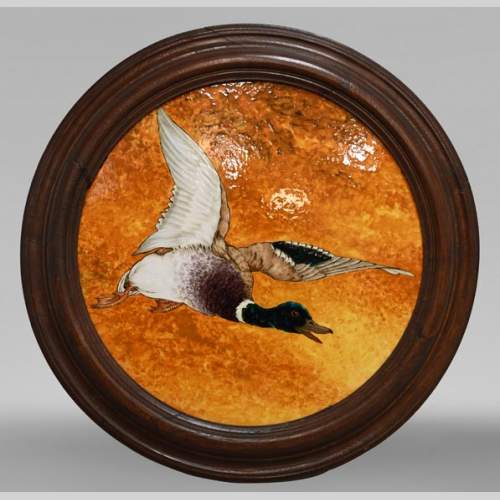
Dimensions:
Height: 5
Diameter: 80
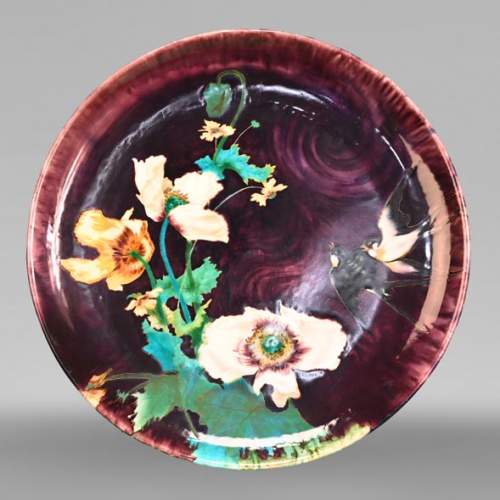
Dimensions:
Diameter: 60
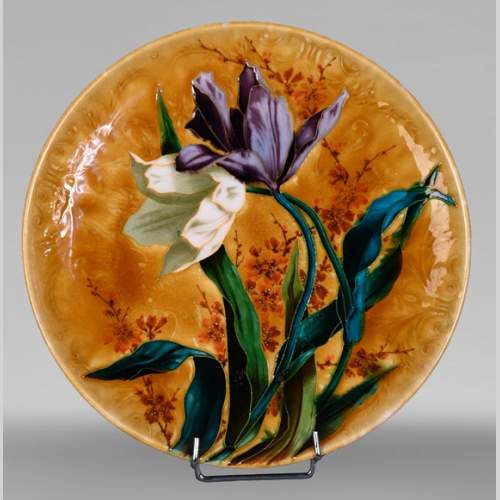
Dimensions:
Height: 4
Diameter: 30
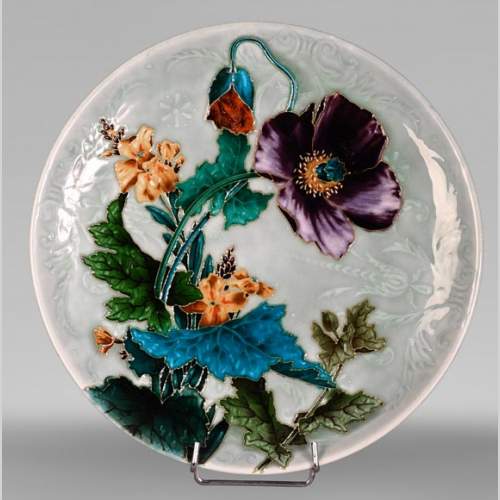
Dimensions:
Height: 4
Diameter: 30
Dimensions:
Height: 20
Diameter: 37
Dimensions:
Height: 4
Diameter: 30
Dimensions:
Height: 8
Diameter: 41
Dimensions:
Height: 8
Diameter: 61
Dimensions:
Height: 33
Diameter: 55
Dimensions:
Width: 38
Height: 25
Depth: 14
Dimensions:
Diameter: 35
Dimensions:
Height: 4
Diameter: 30