Louis Malard (active between 1886 and 1903)
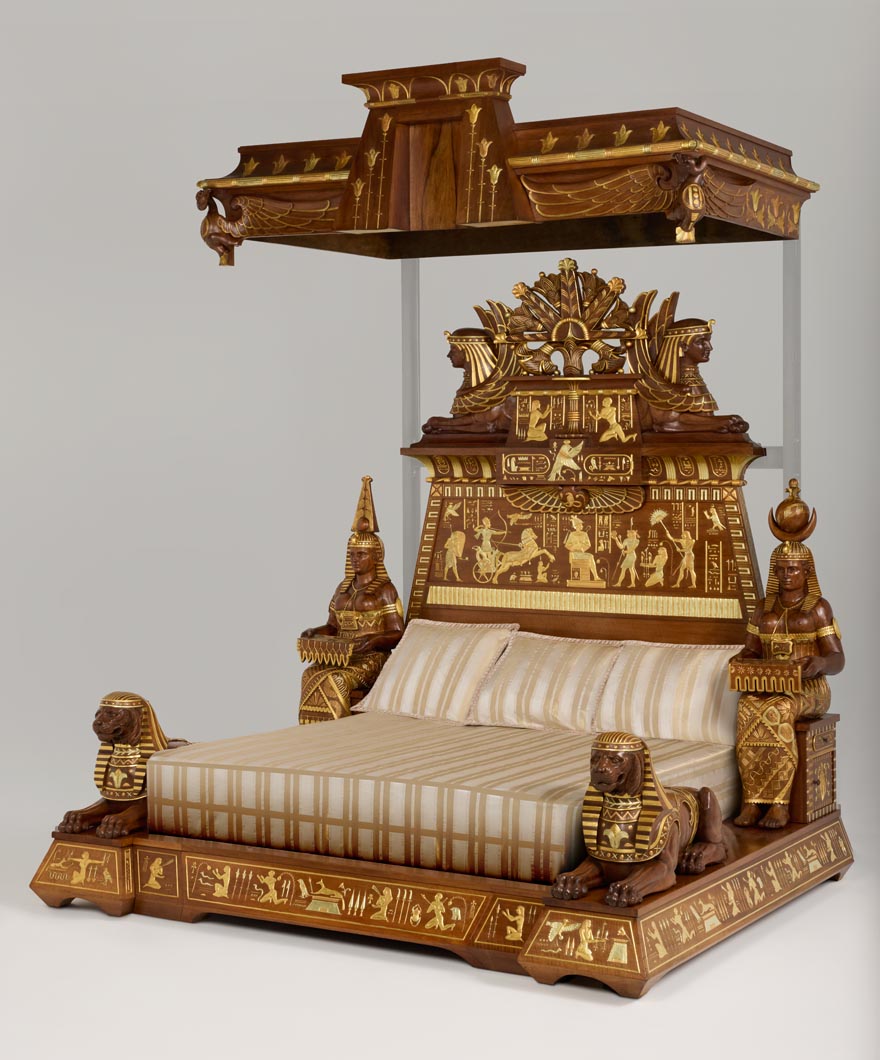
Download PDFLouis Malard belongs to that category of nineteenth-century Parisian craftsmen known through their works rather than through their biography. His firm, on the rue de Maubeuge, produced furniture in every style; a single piece, shown at the 1889 Universal Exhibition, was enough to make his name last: an Egyptian-style bedroom known as the "Ramesside" suite, which ranks among the most spectacular creations of French Egyptomania.
The Malard firm
Louis Malard ran a furniture manufactory and showroom at 9 bis, rue de Maubeuge in Paris, in the district of the Gare du Nord — that is, away from the Faubourg Saint-Antoine, where most Parisian cabinetmaking was then concentrated. His activity is documented between 1886 and 1903. By 1908 a certain Oudard had succeeded him at the same address.
The firm designed and sold furniture in all styles, with a marked preference for historical revivals: its repertoire ran, according to its own advertising, from the age of Dagobert to the Louis XVI style. This practice of period furniture, dominant in Parisian furnishing at the end of the century, did not exclude invention, as the 1889 suite would show.
The 1889 Universal Exhibition
At the 1889 Universal Exhibition, in Group III, class 18 devoted to furniture and accessories, Malard showed a complete Egyptian revival bedroom comprising a bed, a canopy, a bench and two chairs. It earned him a silver medal.
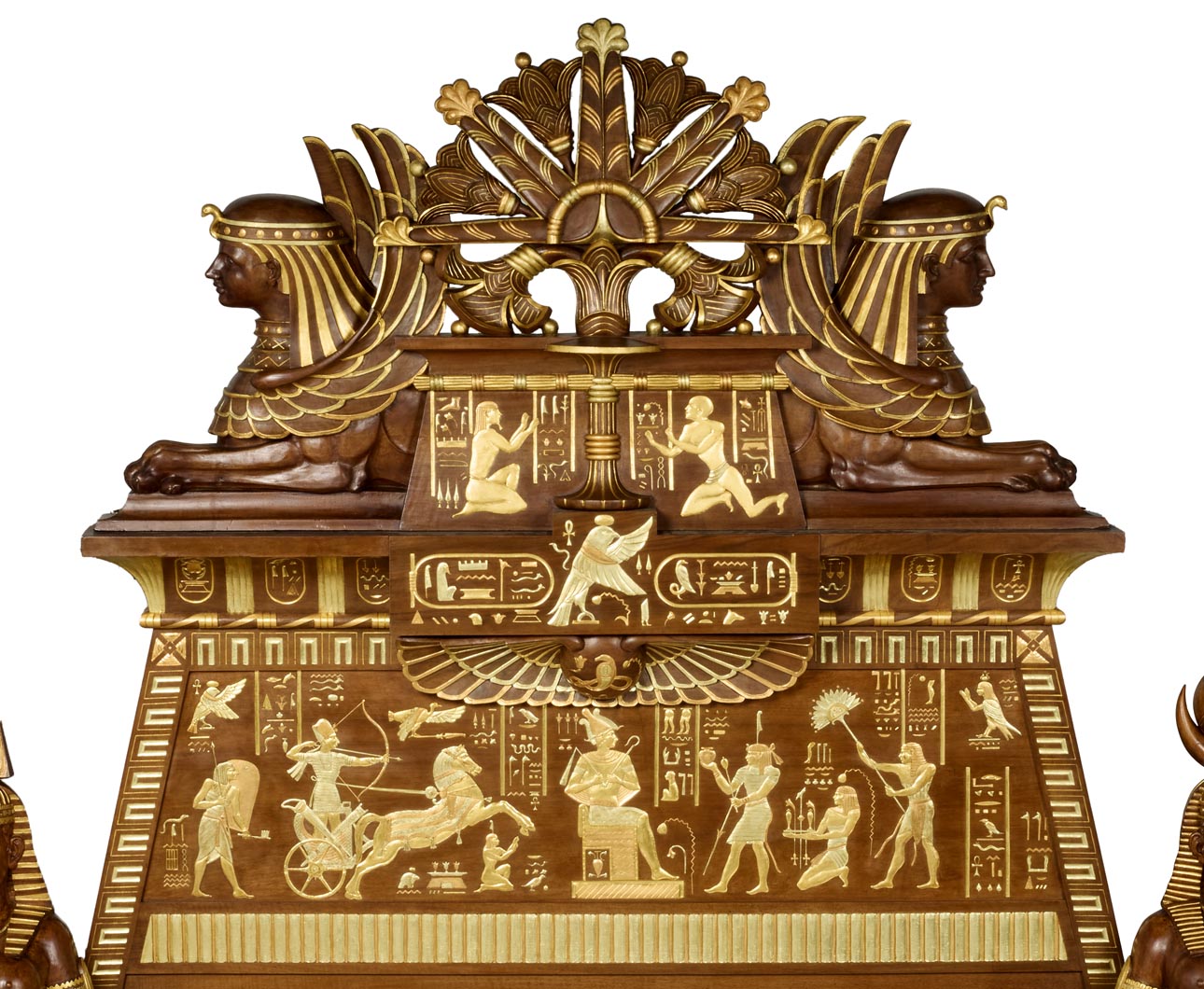
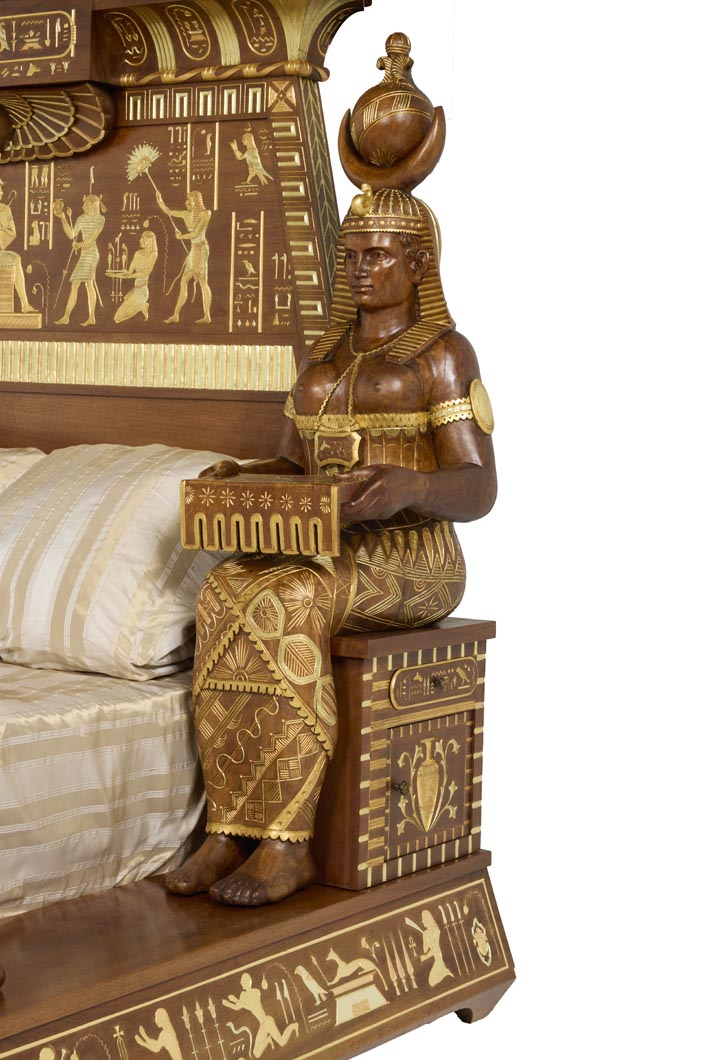
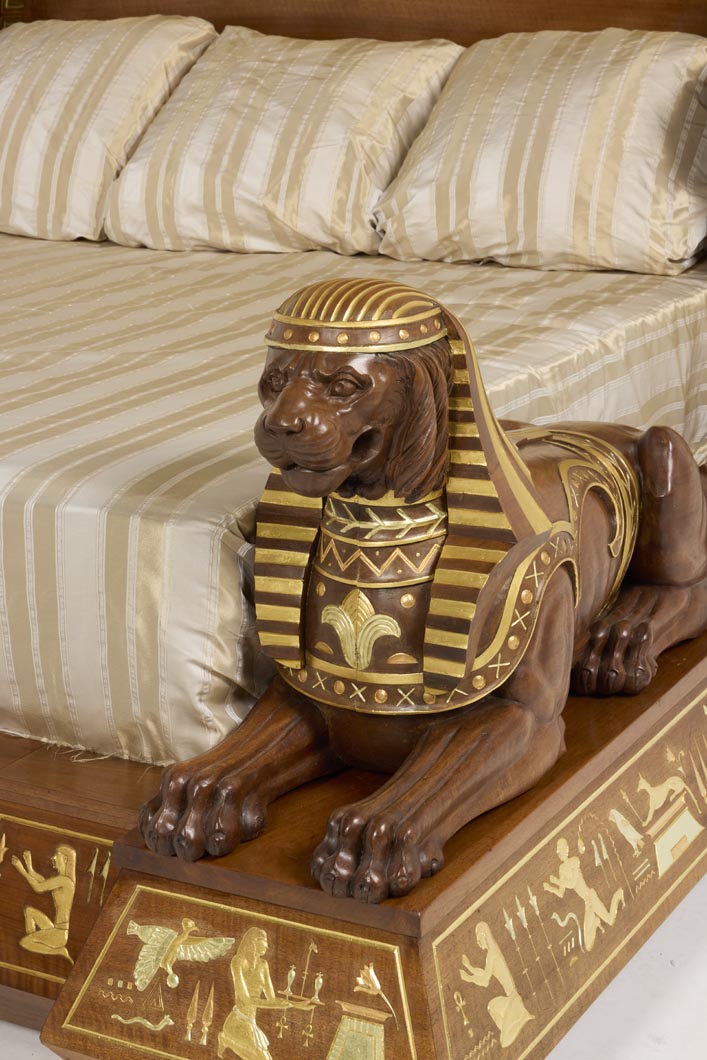
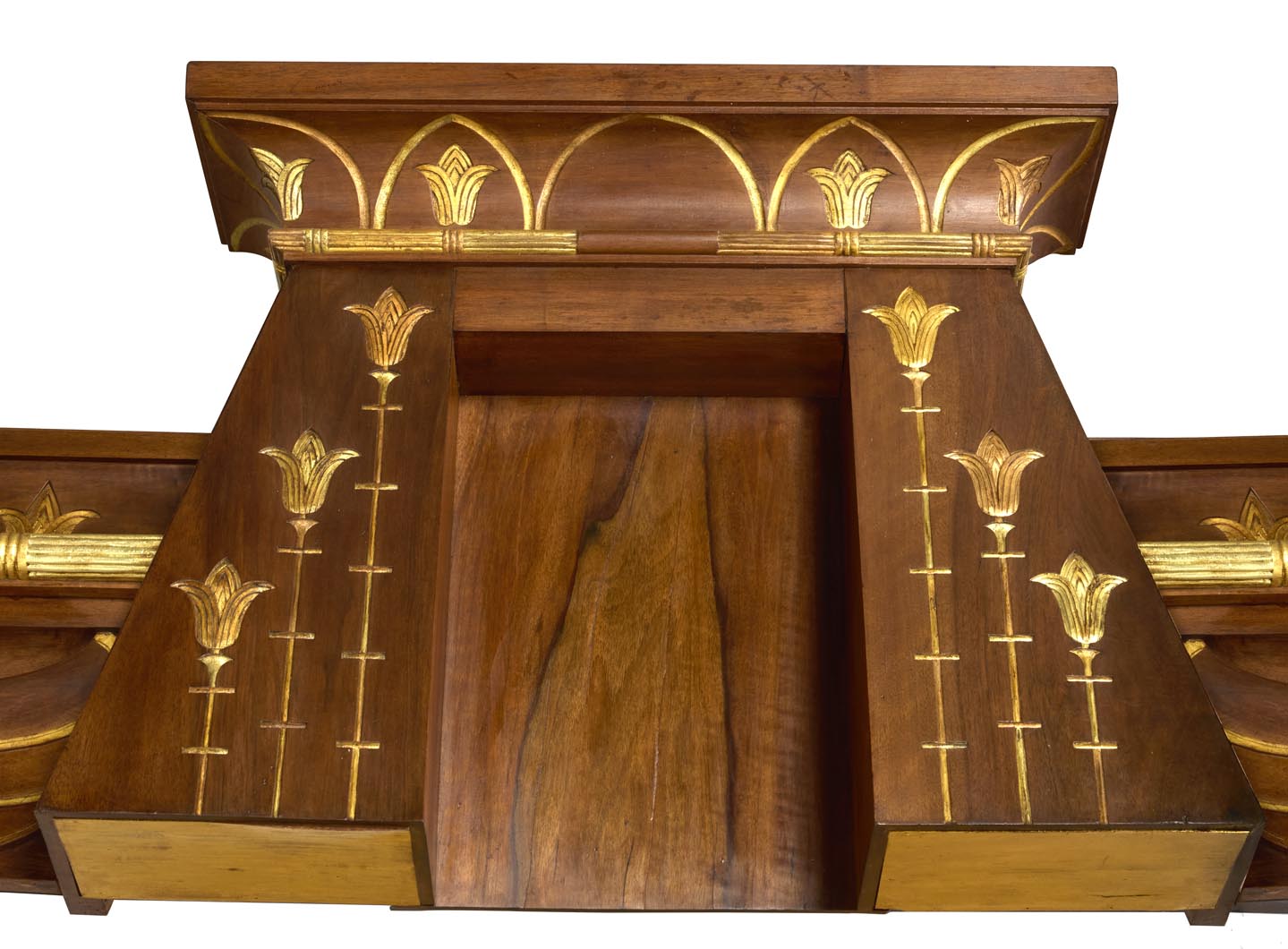
The suite is executed in solid carved and waxed walnut, heightened with three golds — yellow, red and green. The canopy evokes the entrance to an Egyptian temple; the headboard takes the trapezoidal form of a pylon and carries a battle scene in which Ramesses II fights from his chariot, a motif taken from the reliefs of Abu Simbel; two life-size female figures, seated in a hieratic pose, flank the bed and serve as bedside tables; two lions wearing the nemes headdress guard its foot.
This is not an archaeological reconstruction but a free evocation, favouring monumental effect over accuracy. That approach places it squarely within nineteenth-century Egyptomania, a current born of the Egyptian campaign and revived by the great excavations and by the opening of the Suez Canal.
A contemporary account
The work was talked about as soon as it was shown. Le Figaro, in its exhibition column of 1 July 1889, devoted a passage to it, written by the journalist and author Georges Grison (1841-1928). He notes that he had seen it roughed out in Malard's workshops before finding it finished in class 18, which confirms that the piece was conceived specifically for the exhibition. He describes the two almost life-size lions holding in their jaws a rail around which a bronze-green and nasturtium-red drapery is wound, then the Egyptian scenes of the smaller panel: the chariot, the archer, the warrior and the fantastical birds.
Provenance
At the close of the exhibition the suite was acquired by the Comtesse Bathilde Ducos (1851-1927), who kept it until 1896. It then passed into the private collection of Charles Henri Duquesne and remained with his descendants until it reappeared publicly in Paris in 2019.
The 1900 Universal Exhibition
Malard exhibited again at the 1900 Universal Exhibition, where he showed a bedroom of an entirely different kind, combining wood and wrought iron. The jury found it curious and interesting for its utilitarian intention — a telling judgement at a moment when the question of function was beginning to rival that of style. That search for a balance between historical reference and use was already legible, in its own way, in the Egyptian suite of 1889.
Legacy
Documentation on Louis Malard remains thin: his dates of birth and death are unknown, and his work has never been the subject of a comprehensive study. His output is known through exhibition catalogues, through the press of his day, and through the furniture that resurfaces on the market. The Ramesside bedroom remains his best-documented work, and one of the major pieces of the Egyptian taste in French furniture of the late nineteenth century.
See also
Egyptomania — The 1889 Universal Exhibition — The 1900 Universal Exhibition — Gabriel Viardot — Paul Mazaroz — Leroux — The Louis XVI style
See our antique beds and bedroom suites
Bibliography
Period sources
Georges GRISON, "Courrier de l'Exposition", Le Figaro, 35th year, 3rd series, no. 182, Monday 1 July 1889, p. 2 — description of the Ramesside bed, seen by the journalist in Louis Malard's workshops and then finished in class 18.
Exposition Universelle de 1889, official catalogue, Group III, class 18 (Furniture and accessories).
Exposition Universelle de 1900, reports of the international jury, furniture class — assessment of the bedroom in wood and wrought iron.
Studies
Le Cercle Guimard, "Le Faubourg Saint-Antoine et l'Art nouveau, 1895-1905", online study — records Oudard as Louis Malard's successor at 9 bis rue de Maubeuge in 1908.
Provenance and documentation
Brissonneau sale, Drouot Paris, 5 April 2019 — Egyptian revival bedroom, expert Georges Omouri; history of the Ducos and then Duquesne collections.
Galerie Marc Maison, inventory records and photographic documentation.